Home » How to Recycle and Reuse Aluminum Foil: Can You Recycle Aluminum Foil?
Eco-Friendly Furniture
Written by Admin | Nov 20, 2025
What Counts as Eco-Friendly Furniture?
Definition & Core Principles
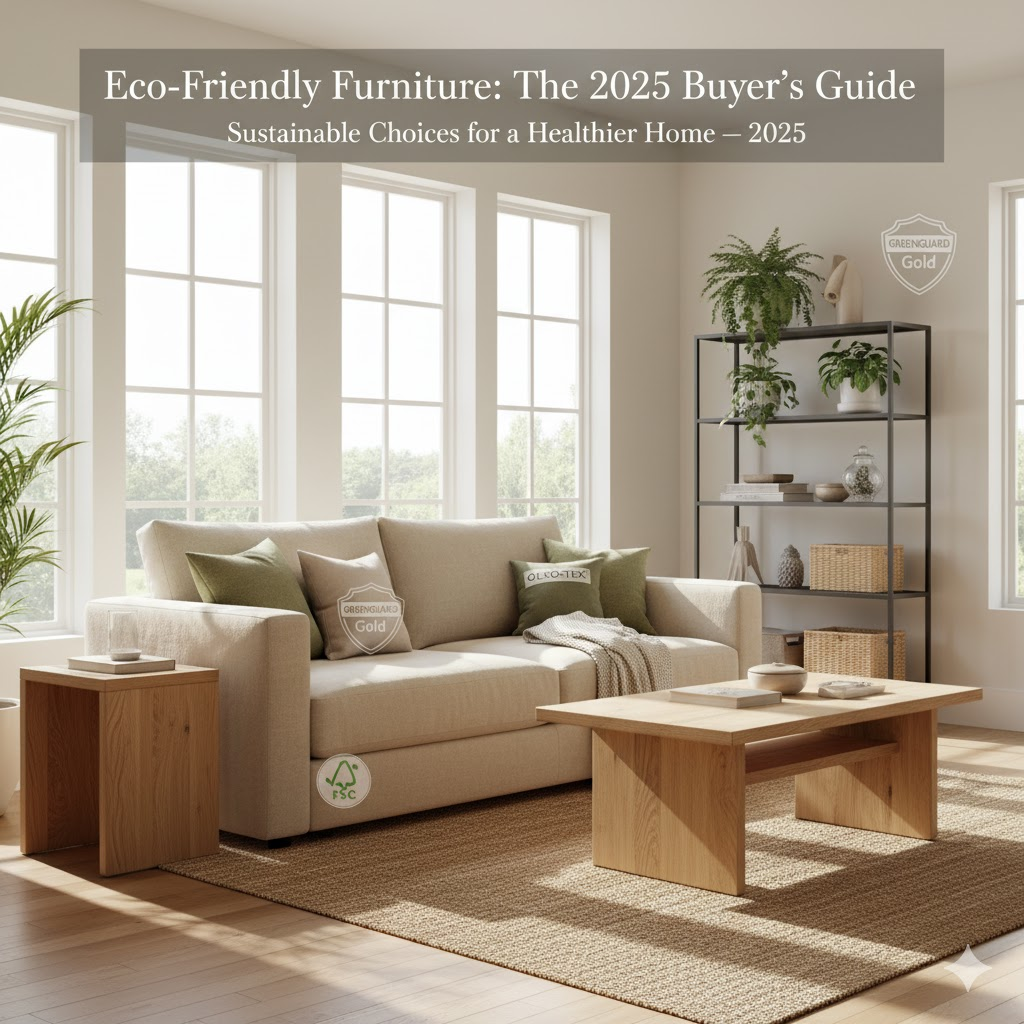
Eco-friendly furniture is designed and made to reduce harm across its life cycle—responsibly sourced materials, low-tox finishes, durable construction, fair labor, and an end-of-life plan that keeps items out of landfills. Think of it as furniture that’s gentler on forests and people, healthier to live with, and easier to repair, reuse, or recycle. FSC and PEFC standards define “responsible” forest sourcing; GREENGUARD Gold and similar labels help verify low chemical emissions; circular programs keep products in use, not in the bin.
(Plain-English add-on) In simple terms: choose pieces made from responsibly sourced wood or recycled metals, finished with low-odor coatings, built to last, and backed by programs that let you repair or pass them on instead of throwing them away.
Key Benefits for Health, Home, and Planet
Choosing low-emission and certified materials supports better indoor air quality (less off-gassing), conserves forests and biodiversity, and cuts energy use and emissions—especially when recycled metals, certified wood, and circular textiles are involved. GREENGUARD Gold furniture is tested to stringent emission limits; recycled aluminum typically needs ~5% of the energy of virgin aluminum, slashing CO₂; FSC wood supports responsible forest management. Those choices don’t just look good—they feel good to live with.
Certifications & Labels You Can Trust
Wood & Forestry (FSC, PEFC)
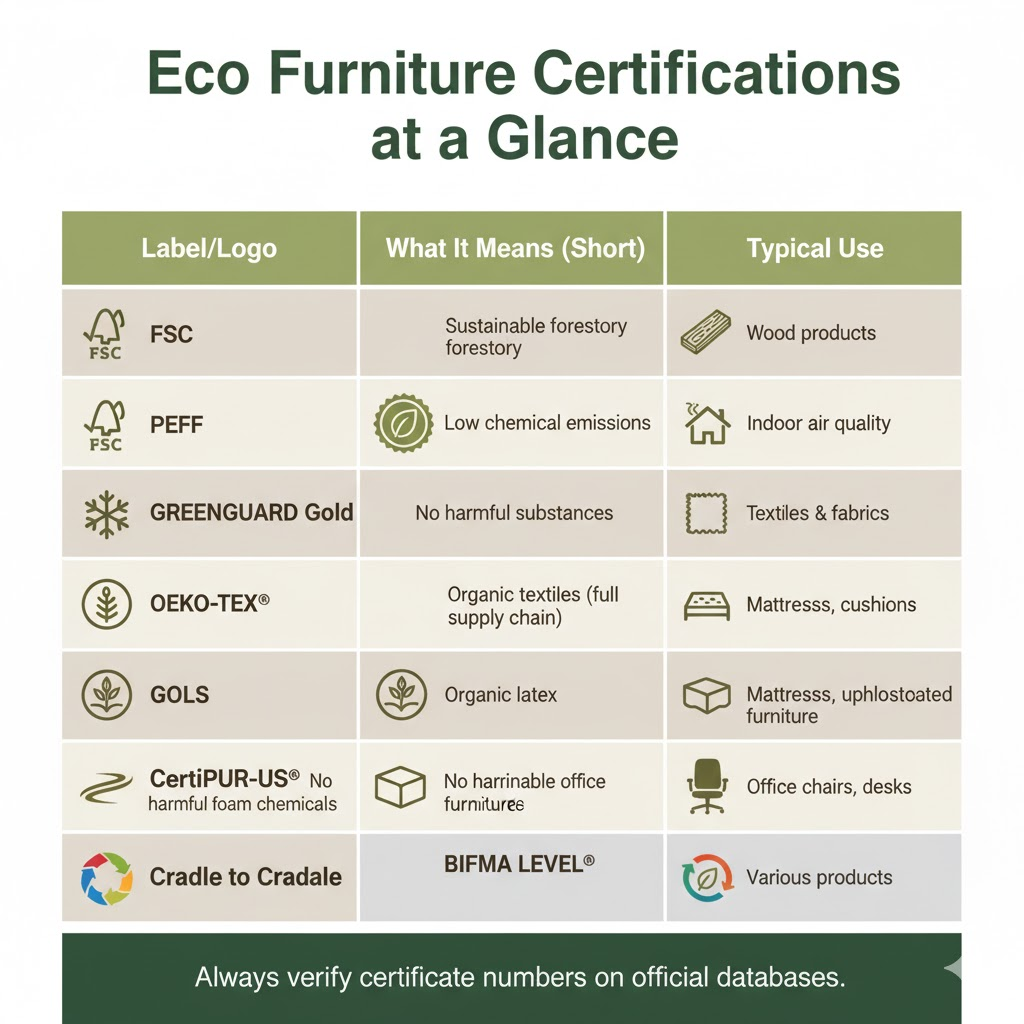
FSC® certifies wood from responsibly managed forests with strict environmental and social criteria. PEFC® is a global alliance endorsing national schemes for sustainable forest management. Either logo on wood, veneer, or paper components is a solid baseline.
Low-Emission Products (GREENGUARD Gold)
UL’s GREENGUARD Gold certifies furniture that meets tougher emission thresholds suitable for sensitive spaces (like schools and healthcare), helping you limit indoor VOC exposure.
Textiles & Leather (OEKO-TEX, GOTS, GOLS)
OEKO-TEX® STANDARD 100 screens textiles for harmful substances. GOTS covers organic fibers plus processing, chemicals, and social criteria. For latex components (e.g., cushions), GOLS indicates organic latex content and audited supply chains. (If you choose leather, look for third-party programs like Leather Working Group, though it’s outside this guide’s core list.)
Foams & Mattresses (CertiPUR-US, Natural Latex)
CertiPUR-US® foams are tested for content and low VOC emissions (≤0.5 ppm total VOC), and made without certain flame retardants, heavy metals, or formaldehyde. Natural latex (preferably GOLS-certified) avoids petro-foam and can offer long service life.
Whole-Product & Systems (BIFMA LEVEL, Cradle to Cradle, Climate Neutral)
BIFMA LEVEL® rates furniture against the ANSI/BIFMA e3 multi-attribute standard (product, facility, and organization). Cradle to Cradle Certified® evaluates material health, circularity, clean energy, water, and social fairness. Climate-Neutral-style labels (rebranded in 2025 as “The Climate Label”) signal company-level climate action and funding of solutions.
How these certifications work (in plain English)
- Independent bodies audit products or materials against published criteria.
- Audits typically repeat on a cycle (e.g., annually or every few years).
- Products get certificate numbers—ask for them.
- Verify numbers on the issuer’s public database (e.g., FSC, UL GREENGUARD, GOTS).
- Scope matters: some labels cover the material only (textile), others the finished product.
Certifications at a glance (copy-friendly table)
| Label | What it means (short) | Typical use |
| FSC / PEFC | Responsible forest management & chain of custody | Solid wood, veneers, paper |
| GREENGUARD Gold | Low chemical emissions from finished products | Casegoods, seating, mattresses |
| OEKO-TEX STANDARD 100 | Textile tested for harmful substances | Upholstery, covers, bedding |
| GOTS / GOLS | Organic fiber or latex + process & social criteria | Fabrics, latex cores |
| CertiPUR-US | Foam content/safety + low VOC | Cushion foam, mattresses |
| BIFMA LEVEL | Multi-attribute sustainability rating | Office furniture & systems |
| Cradle to Cradle | Material health & circularity framework | Components & finished goods |
Safer Materials & Finishes to Prefer

FSC-Certified Solid Wood
Solid wood from FSC-certified forests supports biodiversity and long-term forest health—and it’s repairable and refinishable for decades.
Reclaimed or Salvaged Wood
Reusing timber keeps carbon locked up and avoids fresh logging—ideal for tables, cabinetry, and accents with soulful patina. (Verify treatments/finishes when using indoors.)
Rubberwood (from Spent Latex Trees)
After ~25–30 years of latex tapping, plantation rubber trees become a responsible timber source, reducing pressure on natural forests—great for sturdy frames and tops.
Bamboo
Fast-growing, high-yield, and technically a grass, bamboo can be a low-impact material when responsibly managed and processed—strong enough for frames, tops, and veneers.
Cork
Harvested from bark without felling the tree (typically every nine years), cork is renewable, warm to the touch, and naturally resilient—useful for stools, side tables, and panels.
Responsibly Harvested Rattan
When sourced from well-managed systems, rattan supports forest livelihoods and can reduce incentives for deforestation—perfect for light, airy seating.
Recycled Steel & Aluminum
Metals are durability superstars and endlessly recyclable. Recycled aluminum often saves ~95% energy vs. primary; steel’s recyclability and EAF production pathways cut impacts.
Recycled Plastics (Including Ocean-Bound)
“OBP” refers to plastic waste within ~50 km of coastlines and at risk of entering the ocean; certified OBP and marine-plastic yarns (e.g., SEAQUAL) can be used in frames and fabrics.
Coffee-Ground Composites
Designers now blend spent coffee grounds with binders or recycled polymers to create panels and molded parts—textural, low-waste options for select pieces.
Recycled Glass
Glass can be recycled endlessly without loss of quality and is used in tops, tiles, and hardware; cullet content reduces raw material use and energy demand.
Organic Cotton
GOTS-certified cotton ensures organic fiber plus safer processing—good for slipcovers, cushion shells, and soft goods.
Hemp & Linen (Flax)
Hemp and flax can grow with relatively fewer inputs and offer breathable, tough textiles—ideal for upholstery and drapery in low-tox homes.
Wool (RWS or Equivalent)
RWS wool indicates audited animal welfare and land management—useful in durable upholstery and blankets with natural performance benefits.
TENCEL™ / Lyocell
Wood-based lyocell made in a closed-loop system recovers >99% of solvent—smooth hand, strong fibers, and lower-impact processing.
Natural-Latex Cushions
Look for GOLS or equivalent where possible; natural latex delivers buoyant comfort without conventional petro-foam.
Low-VOC Polyurethane as Lower-Tox Alternative
If you choose polyurethane foam, CertiPUR-US® helps you avoid higher-emitting or chemically problematic formulas.
Non-Toxic, Low-VOC Finishes & Adhesives
Favor water-borne finishes and low-VOC adhesives verified by reputable programs (e.g., GREENGUARD) to limit indoor emissions.
Materials comparison (quick view)
| Material | Best for | Pros | Watch-outs | End-of-life |
| FSC solid wood | Frames, tables | Repairable; refinishable | Check finish VOCs | Refinish / recycle |
| Reclaimed wood | Tables, shelving | No new logging; unique look | Prior treatments | Reuse / recycle |
| Rubberwood | Beds, tables | Uses post-latex trees | Plantation practices vary | Refinish |
| Bamboo | Frames, tops | Fast-growing; strong | Adhesives vary | Reuse / recycle |
| Recycled aluminum/steel | Bases, outdoor | Durable; highly recyclable | Coating chips | Recycle |
| OBP / recycled plastic | Outdoor, fabrics | Waste diversion; easy care | UV/heat stability | Recycle where possible |
| Cork | Stools, panels | Renewable bark; warm feel | Dents under loads | Recycle/compost (binder-dependent) |
| Natural latex | Cushions | Resilient; low-tox | Heat/sun aging | Limited recycling streams |
Chemicals & Treatments to Avoid

PFAS-Based Stain Repellents
“Forever chemicals” used in stain-repellent fabrics are increasingly restricted due to persistence and health concerns—skip them where possible.
Added Flame Retardants (When Not Required)
California no longer requires flame retardant chemicals for upholstered furniture to meet TB117-2013; AB 2998 restricts their sale—proof you can meet safety without these additives.
High-VOC Finishes & Formaldehyde-Heavy Adhesives
Avoid high-VOC lacquers and urea-formaldehyde glues that drive indoor emissions; look for products meeting low-emission standards.
Regulations & Compliance to Know
Formaldehyde Limits (CARB Phase 2 / TSCA Title VI)
Composite wood (MDF, plywood, particleboard) sold in the U.S. must meet formaldehyde emission limits—first set by CARB Phase 2 and now federalized under TSCA Title VI. Ask retailers for compliant documentation.
2025 Updates on PFAS Restrictions in Upholstery Fabrics
California AB 1817 restricts intentionally added PFAS in most textiles (including upholstery fabrics) starting January 1, 2025, with further disclosure requirements to follow; similar restrictions are rolling out in other states.
Design, Durability & Repairability
Solid Joinery, Frames, and Hardware
Seek kiln-dried frames, real-wood joinery (e.g., mortise-and-tenon), and robust fasteners—less wobble today, fewer replacements tomorrow. (BIFMA durability standards are a helpful bar for commercial pieces.)
Replaceable Parts & Modular Designs
Swappable legs, seat pads, and modular panels extend life as styles and needs change—repairs feel empowering, not daunting.
Warranties, Repair Services, and Spare Parts
Brands that publish repair guides, stock parts, and stand behind multi-year warranties reduce waste and give you peace of mind.
Circularity & End-of-Life
Take-Back, Buy-Back & Refurbishment Programs
Large players now run trade-in or resale schemes—e.g., IKEA’s Buy Back & Resell—keeping furniture in circulation longer. Ask local makers, too; many will refurbish their own pieces.
Easy Disassembly for Recycling
Designs that separate wood, metal, and textiles without special tools make recycling practical—not just theoretical. (Look for fasteners over permanent glues.)
Reupholstery and Refinishing Pathways
Sturdy frames can get new life with fresh foam/fabric and low-tox finishes; many cities have skilled refinishers—keeping heirlooms alive and loved.
Responsible Sourcing & Footprint
Local Manufacturing & Short Supply Chains
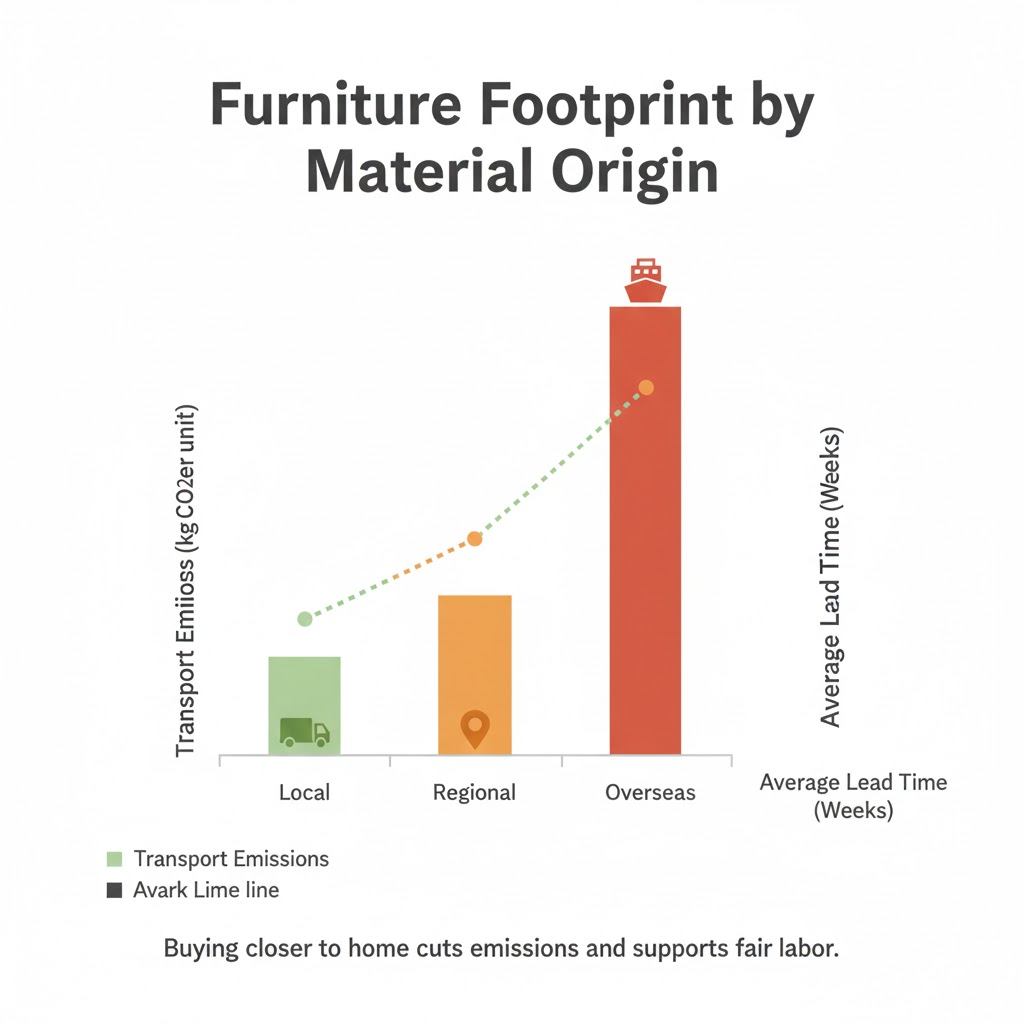
Buying closer to home often means lower transport emissions and more transparent labor practices—plus faster service if you need a repair.
Made-to-Order vs. Mass-Produced (Waste Reduction)
Made-to-order models reduce overproduction and warehouse waste—your piece exists because you truly wanted it.
Low-Impact Packaging & Shipping
Prefer recycled/recyclable packaging and consolidation shipping; FSC-certified corrugate is a plus.
How to Shop for Eco-Friendly Furniture (Step-by-Step)
Set Priorities & Budget
Decide what matters most (e.g., low-tox indoor air, certified wood, recycled content) and allocate budget to highest-impact pieces first.
Vet Materials & Verify Certifications
Ask for specific certificate numbers (FSC, PEFC, GOTS, OEKO-TEX, GREENGUARD Gold, LEVEL, GOLS, CertiPUR-US) and look them up on issuer sites.
Inspect Build Quality (In-Store or Via Specs/Photos)
Check joinery, frame materials, fabric rub counts, and whether cushions are zippered for easy replacement—details that quietly add years.
Compare New vs. Secondhand & Vintage
Well-made secondhand pieces can outperform new budget items; reupholster with OEKO-TEX or GOTS fabrics for a fresh, low-tox update.
Smart Questions to Ask Retailers & Makers
Ask: “What’s the wood source and certification?” “Foam certification?” “Finish VOC details?” “Repair parts available?” “Take-back at end-of-life?” A good brand will have clear answers.
Buyer pitfalls & fixes (Troubleshooting)
- Retailer can’t provide certificate numbers → ask for spec sheet or choose a verified alternative.
- Strong chemical odor on delivery → air out 48–72 hours; if persistent, request return/exchange.
- Claims say “sustainable wood” with no details → ask “FSC/PEFC?” and origin species.
- Cushions flatten fast → choose replaceable cores (natural latex or CertiPUR-US), zippered covers.
Decision aid (what to buy first)
- If indoor air is your top priority → GREENGUARD Gold product + water-borne finishes + natural latex or CertiPUR-US foam.
- If longevity is #1 → FSC hardwood frame + replaceable parts + refinishable surfaces.
- If circularity is #1 → Take-back program + recycled aluminum/steel + modular design.
Room-by-Room Recommendations
Living Room Seating & Tables
Prioritize FSC solid wood frames, CertiPUR-US (or natural-latex) cushions, and OEKO-TEX/GOTS fabrics. Consider recycled-metal bases and coffee-ground or recycled-glass accents for story-rich details.
Bedroom (Bed Frames, Mattresses, Dressers)
Choose FSC/PEFC bed frames with low-VOC finishes; mattresses with natural latex or low-VOC polyurethane (CertiPUR-US), and textiles certified by GOTS or OEKO-TEX.
Dining & Kitchen Seating
Hard-wearing tops in FSC wood or recycled glass, chairs in rubberwood, bamboo, or recycled metal; stain protection without PFAS.
Home Office (Desks, Chairs, Storage)
Look for BIFMA LEVEL-certified products for a balanced view of material health, energy, and social metrics; confirm formaldehyde-compliant composite woods.
Outdoor Furniture (Weather-Safe, Low-Maintenance)
Recycled aluminum and steel resist weather and are highly recyclable; FSC teak (or reclaimed) where appropriate; marine-plastic fabrics (e.g., SEAQUAL) for cushions.
(Reader story suggestion) A young family swapped a sagging foam sofa for an FSC hardwood frame with natural-latex cushions and OEKO-TEX fabric—reporting fewer odors and better comfort in the first week.
Care & Maintenance for Longevity
Low-Tox Cleaning & Routine Care
Choose EPA Safer Choice-verified cleaners; dust textiles regularly and wipe spills quickly to avoid harsh spot-treatments later.
Repair, Refinish & Reupholster to Extend Life
Refinish solid wood with water-borne coatings; reupholster cushions in certified fabrics; replace hardware before it fails—small acts that keep memories (and materials) alive.
Frequent Ask Questions

James Parker
James Parker is an environmental expert, writer, and the founder of Envirose.com. Over the years, he has dedicated his work to studying sustainable practices, renewable energy solutions, and eco-conscious lifestyles. Through Envirose, he aims to inspire individuals to make small yet powerful changes in their daily lives that can collectively create a positive impact on the planet. When he’s not writing or researching, you’ll often find him outdoors, exploring nature and finding new ways to live in harmony with it.