Home » How to Recycle and Reuse Aluminum Foil: Can You Recycle Aluminum Foil?
Non-Toxic Cooking Utensils
Written by Admin | Nov 20, 2025

Why Non-Toxic Utensils Matter
If you’ve ever paused mid–stir-fry wondering what your spatula is leaving behind, you’re not being paranoid—you’re being careful. Certain utensils can release chemicals into hot, fatty, or acidic foods, and a few materials (especially some plastics and “bamboo-plastic” mixes) have been flagged by regulators and researchers for leaching or contamination issues. For example, recent studies found brominated flame retardants in a variety of black plastic items—including kitchen utensils—likely from recycled electronics; these additives are linked to endocrine and developmental harms.
At the same time, safer choices absolutely exist. Stainless steel, well-made wood and bamboo, and high-quality silicone (within its limits) can deliver years of calm, reliable cooking without the chemical second-guessing.
What Makes a Utensil “Non-Toxic”?
Food-contact regulations & certifications (LFGB, FDA, REACH)
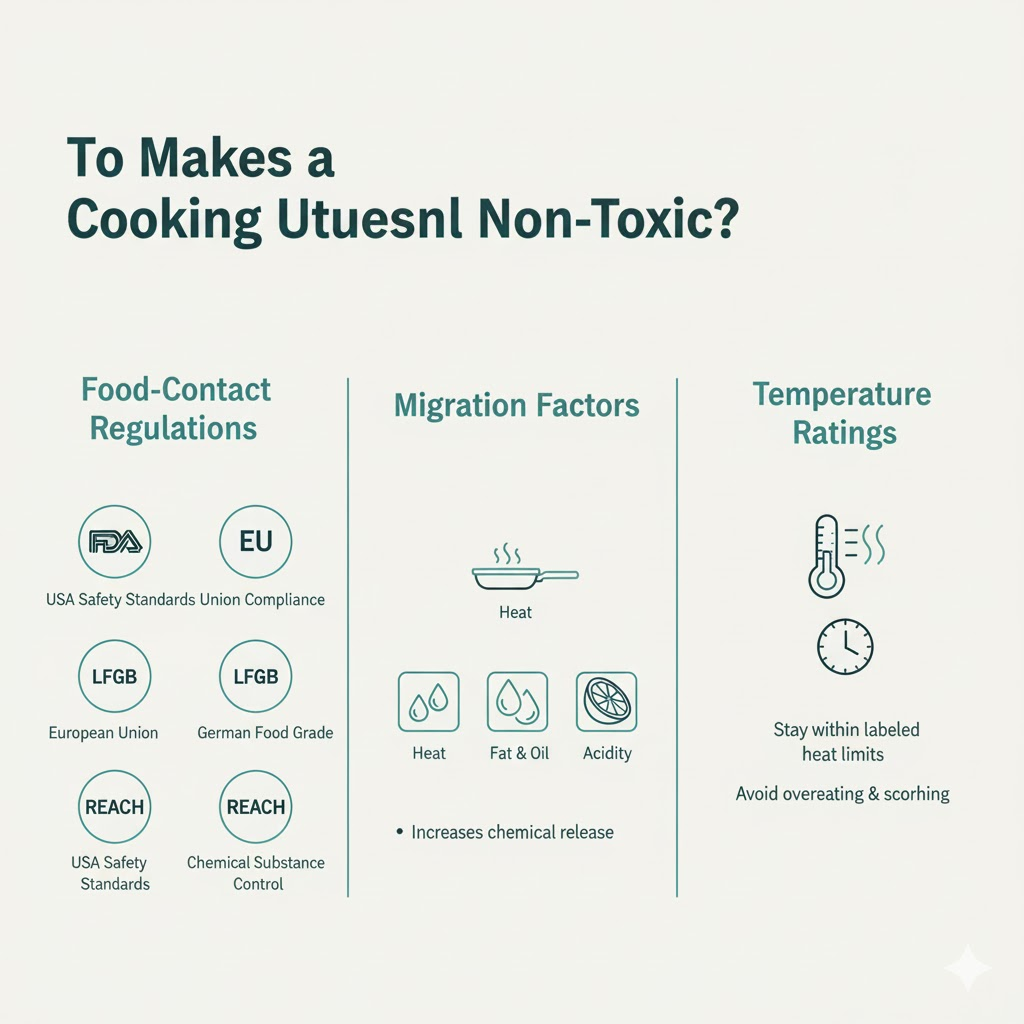
“Food safe” isn’t a vibe; it’s about meeting specific rules:
- FDA (U.S.) regulates food-contact substances by material and intended conditions of use (time, temperature, and food type). Compliant materials must be cleared in 21 CFR or via an FDA Food Contact Notification.
- EU frameworks (e.g., Reg. 1935/2004 and Reg. 10/2011 for plastics) require materials not to transfer constituents in quantities that could endanger health or change food unacceptably.
- LFGB (Germany) is often referenced on products sold globally; manufacturers use BfR recommendations and migration testing to show compliance with German food-contact requirements.
- REACH (EU) isn’t a “food-safe” mark; it’s a chemicals law that can restrict substances of concern (e.g., cyclic siloxanes D4/D5/D6) across product categories.
Bottom line: Look for explicit statements about FDA/EU food-contact compliance and, for wood/bamboo, credible sourcing certifications (e.g., FSC) rather than vague “eco” badges.
Heat, fat, and acidity: how migration happens
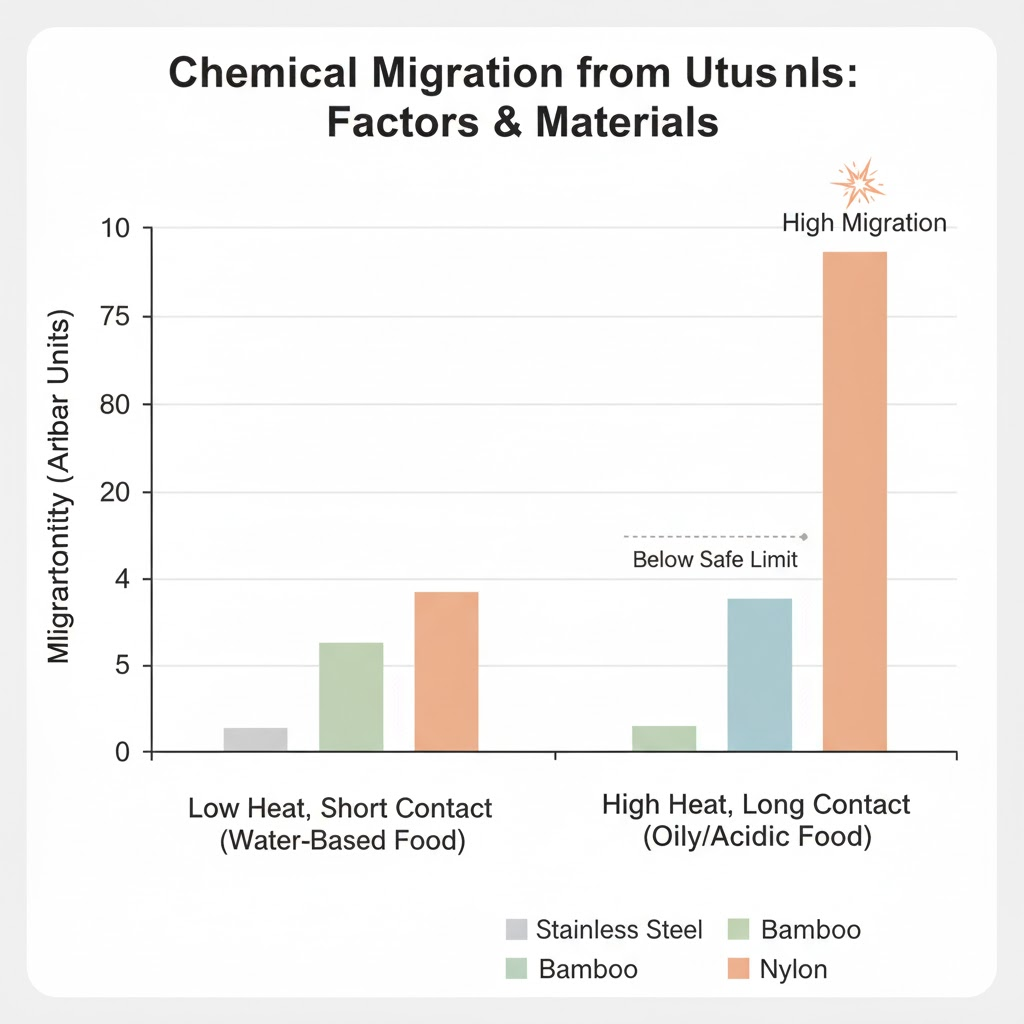
Chemical transfer rises with temperature, contact time, and food “extractiveness” (oily/fatty or acidic). That’s why a cool salad bowl is different from a sizzling skillet. Higher heat and fatty sauces generally drive more migration.
Temperature limits: what ratings actually mean
Utensil labels (e.g., “heat-safe to 425°F/220°C”) reflect the conditions the material has been tested to tolerate without excessive migration or deformation. Regulators and labs define test conditions by time, temperature, and food simulants; those ratings aren’t an invitation to push hotter or longer.
Safest Materials (Pros, Cons, Best Uses)
Stainless steel (304/316)
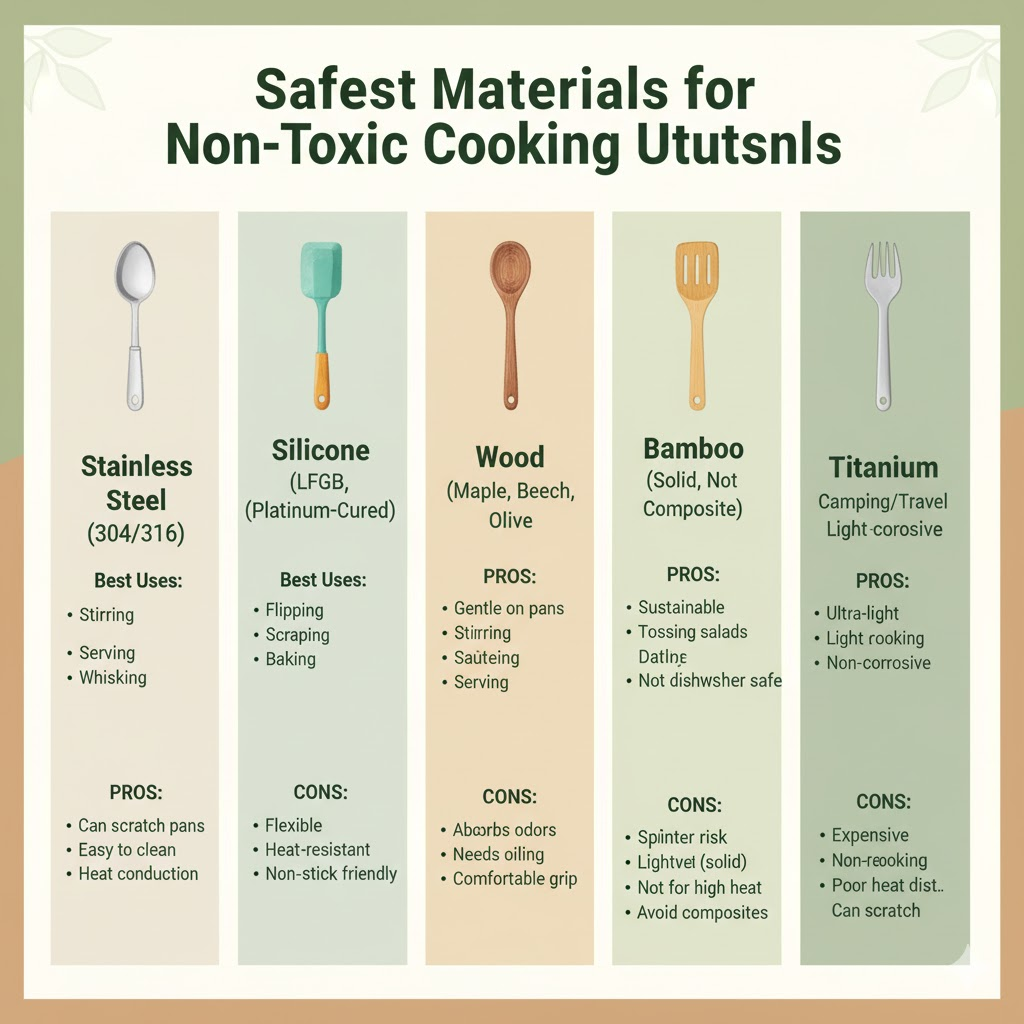
Why choose it: Inert, rugged, endlessly recyclable, and easy to sanitize. Grade 304 (18/8 or 18/10) is the kitchen workhorse; 316 adds molybdenum for extra corrosion resistance (great for briny, acidic work). For nickel-sensitive users, 18/0 (no nickel) exists with slightly less corrosion resistance.
Best uses: High-heat searing, scraping on steel or cast-iron cookware, ladles, whisks, tongs.
Watch-outs: Don’t use metal on delicate nonstick or sol-gel “ceramic” coatings (you’ll scratch them).
Food-grade silicone (prefer LFGB / platinum-cured)
Why choose it: Flexible, heat-tolerant, non-reactive in typical stovetop use, gentle on coatings. Overall migration tends to drop after a few heat cycles.
Best uses: Bowl scrapers, jar spatulas, nonstick-safe turners.
Watch-outs: At very high baking temps, cyclic siloxanes and volatiles can be released; keep within labeled temps and avoid charring. Pre-heating new molds/utensils a few times reduces initial emissions. Prefer platinum-cured, LFGB-tested products.
Solid wood (maple, beech, olive) with food-safe finishes
Why choose it: Pleasant hand-feel, naturally antimicrobial behavior documented in cutting-board research, and renewable when responsibly sourced (look for FSC).
Best uses: Stirring, sautéing on coated pans, serving.
Watch-outs: Avoid mystery lacquers/varnishes on the working end; choose unfinished or finishes labeled food-safe (e.g., mineral oil, beeswax). (See care section for oils.)
Solid bamboo (non-composite)
Why choose it: Hard, light, renewable; similar care to wood.
Best uses: Daily stirring/turning, serveware.
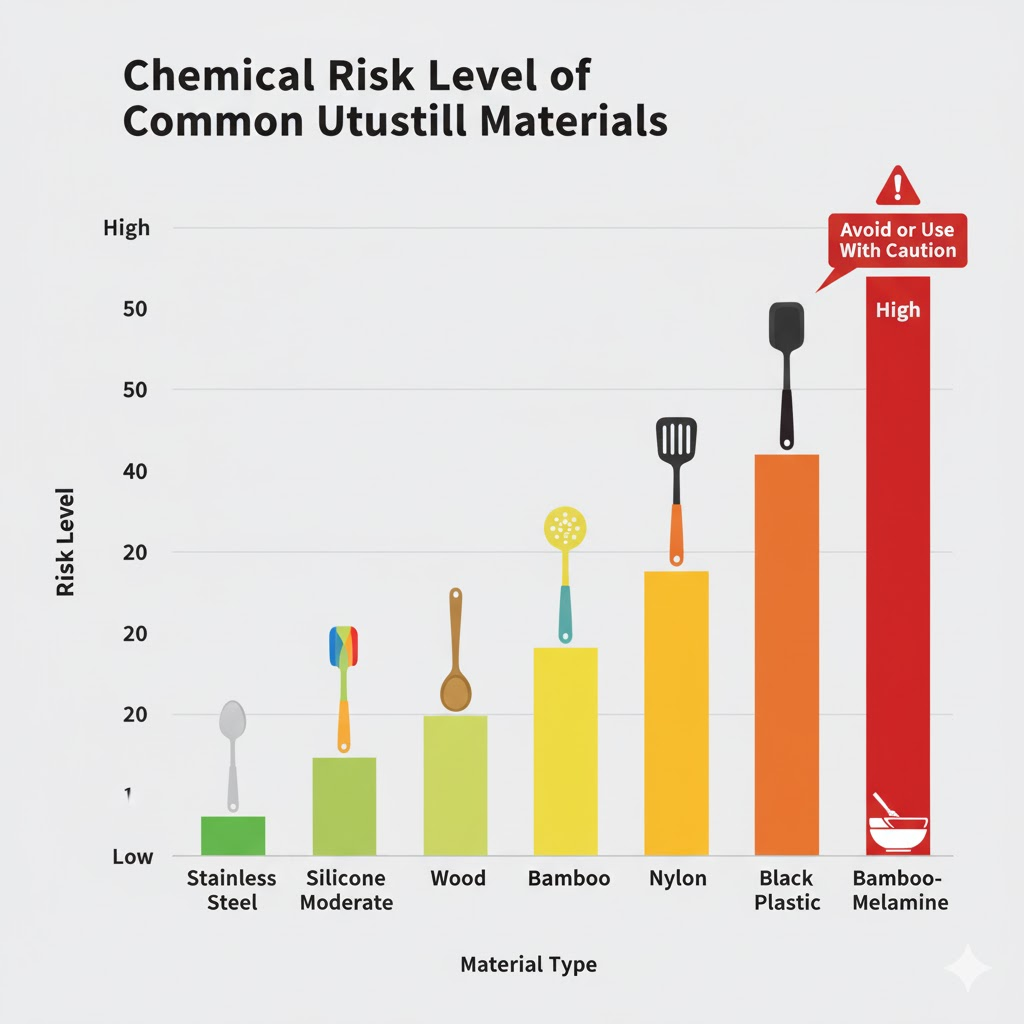
Watch-outs: Do not confuse solid bamboo with bamboo-melamine composites (“bamboo plastic”)—those are very different and widely restricted in the EU for exceeding melamine/formaldehyde migration.
Titanium (lightweight / camping)
Why choose it: Ultra-light, corrosion-resistant, non-reactive—ideal for backpacking kits or minimalist kitchens.
Best uses: Camping sporks, tongs, simple turners with rugged cookware.
Watch-outs: Pricier; pure titanium utensils can feel stiff and “pingy.” (Many “titanium” consumer tools are simply titanium-alloy or coated.)
Materials to Avoid or Use With Care
Bamboo-melamine composites (“bamboo plastic”)
EU authorities found these unauthorized as plastic FCMs; enforcement actions targeted market withdrawal due to frequent melamine/formaldehyde migration over legal limits. If a “bamboo” utensil feels plastic-like and says “melamine,” skip it.
Nylon/polyamide and other low-heat plastics
Polyamide (nylon) utensils have shown primary aromatic amine (PAA) migration in testing campaigns; PAAs include compounds of toxicological concern. Heat, oils, and dyes can worsen migration.
Black plastic utensils (recycled-content & additive concerns)
Studies have reported brominated flame retardants and other contaminants in black plastics—likely from recycled e-waste streams—turning up in consumer goods including kitchen utensils. Avoid black plastic, especially unknown brands.
Lacquered/varnished wood without food-safe labeling
Clear, glossy finishes may contain solvents or resins not intended for hot, acidic, or oily food contact. Choose unfinished tools or ones finished with clearly labeled food-safe oils/waxes. (See label-reading tips below.)
Match Utensils to Your Cookware
Nonstick & ceramic-coated pans
Use silicone or wood to protect coatings; most makers explicitly advise no metal (even one scratch can snowball into sticking).
Stainless steel & carbon steel
Stainless or titanium utensils shine here—confident scraping and deglazing without worry. (Carbon steel seasoning tolerates brief metal contact during cooking.)
Cast iron & enameled cast iron
Bare cast iron: metal tools are fine for flipping and scraping.
Enameled: treat like other coated surfaces—favor wood or silicone to avoid micro-chips.
How to Shop Smarter
Reading labels and verifying materials
Look for “meets FDA 21 CFR” or “complies with EU 1935/2004 / 10/2011” and, for silicone, LFGB-tested. For wood/bamboo, prefer FSC-certified sourcing.
One-piece builds vs. glued handles & inserts
Seamless, one-piece silicone or single-material tools leave fewer places for grime and adhesive failures. If parts are mixed, ensure the food-contact end is the inert material (e.g., steel head with a silicone or wood handle—not the reverse for coated pans).
Temperature ratings to look for
For stovetop use, silicone labeled ~425°F/220°C is typical; keep under stated limits and avoid contact with heating elements or dry, empty-pan searing. Testing regimes are set by time/temp/food simulants—respect those guardrails.
Spotting greenwashing in “eco” utensil claims
Beware of “bamboo fiber” plastics and vague lines like “BPA-free” used to sell silicone (BPA isn’t used in silicone). Prioritize specific standards and migration testing over buzzwords.
Care & Maintenance for Safety and Longevity
Cleaning by material (silicone, wood, stainless)
- Silicone: Dishwashable; first few uses can “off-gas”—a couple of dry heat cycles help. Retire if you see cracks or powdery surfaces.
- Wood/Bamboo: Hand-wash, quick dry; avoid soaking and dishwashers to prevent warping.
- Stainless: Dishwasher-safe; if tea-colored film appears, a baking-soda paste or stainless cleaner restores shine.
Conditioning wood (oils & waxes)
Use food-grade mineral oil and/or beeswax blends; skip vegetable oils that can turn rancid. Condition when the surface looks dry and no longer beads water. (FSC labels help with responsible sourcing; oils/waxes should state food-contact suitability.)
Signs it’s time to replace a utensil
Splits or raised grain on wood; nicks or loosened seams on silicone; warped nylon; or any tool that smells “chemical,” chalks, or crumbles under heat.
End-of-Life & Sustainability
Repair and compost options for wood & bamboo
Light sanding can rescue rough wooden tools. Unfinished wood/bamboo can go to home compost; lacquered items should go to trash due to coatings.
Recycling paths for stainless steel
Stainless steel is a recycling champion—it’s widely accepted at scrap/recycling centers and retains quality through repeated cycles. Drop off at a local metal recycler.
Silicone take-back / mail-in programs
Conventional municipal recycling rarely accepts silicone. Look for brand take-backs or mail-in options (e.g., TerraCycle boxes or retailer programs) that handle silicone elastomers alongside hard-to-recycle household goods.
Non-Toxic Essentials Checklist (By Tool)
Spatulas & turners
- For nonstick/ceramic: Platinum/LFGB silicone or wood; avoid edges that get “wire-thin.”
- For steel/cast iron: Stainless fish turner or straight-edge spatula.
Spoons & ladles
- Sauces & soups: Stainless ladle; wood or silicone spoons for coated pans.
- Tasting/spoonulas: Small silicone scrapers for jars and bowls.
Tongs
- High-heat searing: Stainless with smooth edges.
- Coated cookware: Stainless arms with silicone tips.
Whisks
- Everyday: Stainless balloon whisk; silicone-coated wires only for delicate coatings.
Scrapers & bench tools
- Dough/bench: Stainless bench scraper on bare counters; plastic/silicone bench blades only for coated bakeware (kept below temp limits).
Frequent Ask Questions

James Parker
James Parker is an environmental expert, writer, and the founder of Envirose.com. Over the years, he has dedicated his work to studying sustainable practices, renewable energy solutions, and eco-conscious lifestyles. Through Envirose, he aims to inspire individuals to make small yet powerful changes in their daily lives that can collectively create a positive impact on the planet. When he’s not writing or researching, you’ll often find him outdoors, exploring nature and finding new ways to live in harmony with it.