Solar Electric Bike
Written by Admin | Nov 20, 2025
Integrated vs. Solar-Charged (External Panels) — Key Differences
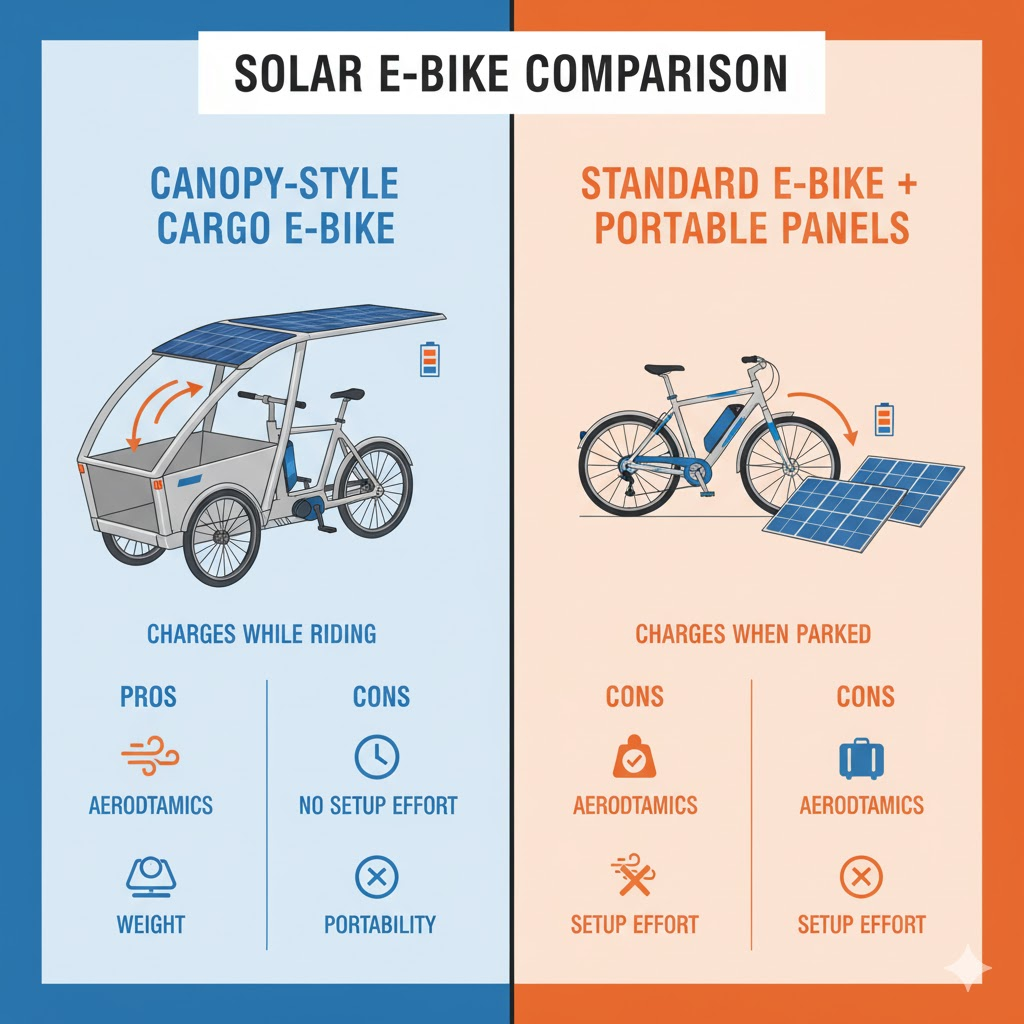
Quick answer: Integrated systems charge whenever they see sun but add weight/drag; external foldables avoid aero penalties while riding and can be larger, but need setup time and the right electronics.
Integrated solar (on-bike)
Panels are mounted permanently (e.g., cargo canopies). Pros: charge while parked or rolling, turnkey wiring. Cons: added weight/drag, higher cost, limited panel area.
External/portable solar
Foldable panels deployed at camp stops, on trailers, or racks; common with “power-station” e-bikes. Pros: larger wattage possible, flexible setup, no aero penalty while riding if stowed. Cons: setup time; needs MPPT/boost hardware to match battery voltage.
How Solar Electric Bikes Work
Quick answer: Sunlight → panels → MPPT/boost controller (optimizes/steps voltage) → battery → motor/controller assists pedaling.
Sunlight hits PV cells → DC power flows into a controller that optimizes/steps voltage → energy goes to the e-bike battery → your motor/controller draws from the battery to assist pedaling.
Panels → MPPT/Boost Controller → Battery → Motor/Drive System
Plain-language glossary add: MPPT (maximum power point tracking) is a smart charger that constantly finds the best voltage/current combo from your panels to pull the most power. Boost stages raise panel voltage to your pack’s required charge voltage.
MPPT charge controllers maximize panel output under changing light; they can also include boost stages to reach e-bike charge voltages. Using MPPT typically yields faster, steadier charging than simple PWM.
Many DIY builds add a DC-DC boost so modest 18–24V panels can safely charge 36–52V packs (or 54.6V for a 13s/48V pack).

Battery Voltages (36V/48V/52V/72V) & Compatibility
Quick answer: Match your controller to your battery’s charge voltage (e.g., ~54.6 V for 48 V/13s).
Glossary add: Wh (watt-hours) = energy capacity; Wp (watt-peak) = panel rating at ideal conditions.
Most e-bikes use 36V, 48V, or 52V packs; high-performance light e-moto platforms may use 60–72V. Your solar hardware (controller/boost) must be sized to the pack’s charge voltage (e.g., ~54.6V full for 48V/13s).
Architectures & Options
Quick answer: Three realistic paths—(1) integrated canopy panels on cargo/utility frames, (2) standard e-bikes plus foldable panels/compatible electronics, (3) small trailers/canopies to add panel area.
Integrated-Solar Cargo/Utility E-Bikes
Cargo platforms with roof or fairing panels (e.g., SunRider) can offset a significant portion of daily energy for last-mile delivery in sunny climates.
Standard E-Bikes with Portable/Folding Solar Panels
“Power-station” e-bikes (e.g., Mokwheel) support branded inverters and foldable panels for camp charging, letting riders top up the main battery and power AC/DC devices.
Trailers & Canopies as Range Extenders
Small PV trailers (100–300W) add area without destabilizing the bike; popular in solar-bike rallies like The Sun Trip, which caps visible panel area to keep builds practical and safe.
Comparison Table
| Setup | Typical Panel Area / Wp | Aero Impact While Riding | Setup Effort | Best For |
| Integrated cargo canopy | ~0.5–1.5 m² / ~200–550 Wp | Medium (fixed surface) | Low (always on) | Fleets, utility, delivery routes |
| Portable/foldable panels | 100–230 W | None if stowed | Medium (deploy at stops) | Touring, camping, home charging |
| Small trailer/canopy | 100–300 W | Low–Medium | Medium | Long tours needing more area |
Is a Truly “Self-Charging” Solar E-Bike Realistic?
Quick answer: For most riders, solar extends range rather than replaces the wall. Self-charging becomes plausible with ~500 Wp on a cargo canopy in strong sun; loads, routes, and seasons decide the rest.
Expected Solar Energy vs. Typical E-Bike Consumption
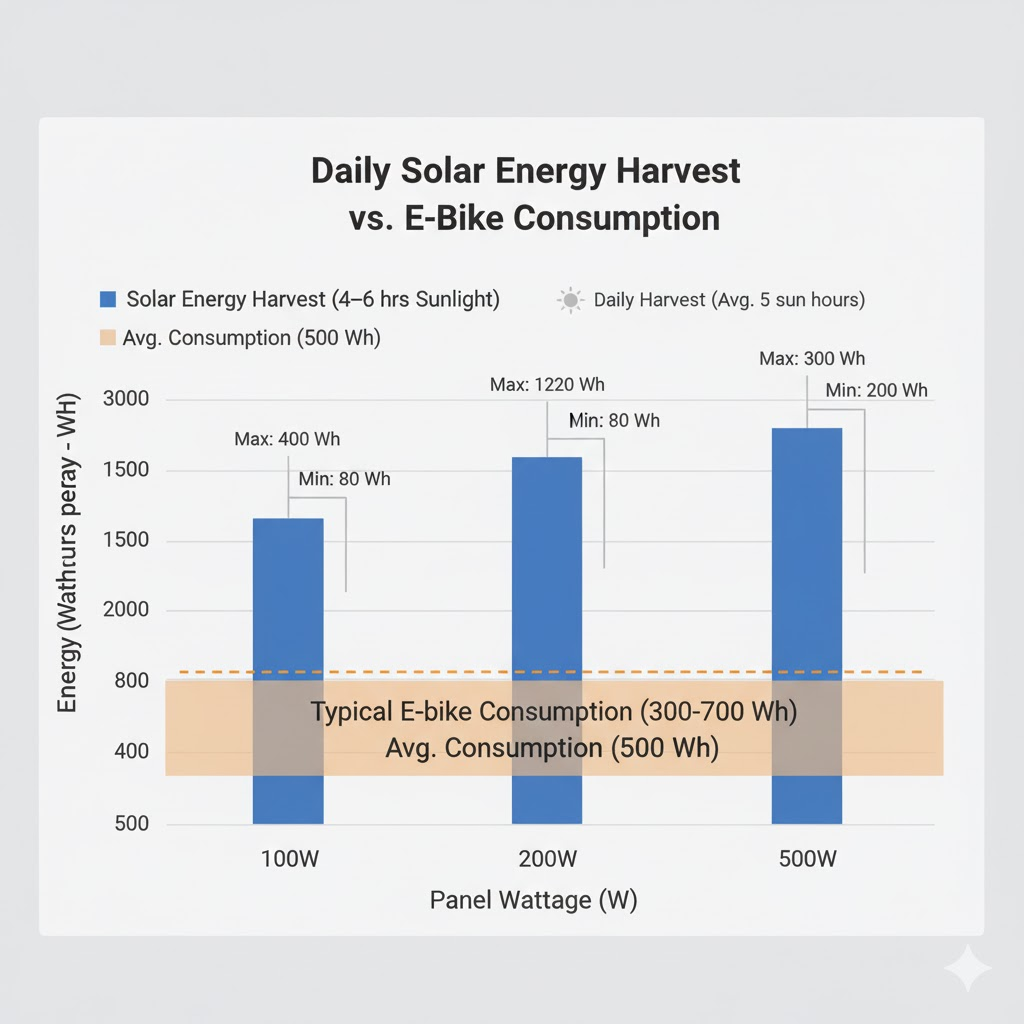
A 200–550 Wp array can add meaningful range on bright days. For instance, SunRider cites up to ~100 km/day solar-assisted range in strong sun, tied to its ~545 Wp array; real-world results vary with load, route, and weather. Typical e-bike energy use spans wide ranges; published analyses show range depends more on battery size, speed, and terrain than a single universal Wh/km figure.
Location/Season/Weather Effects on Real-World Range
Glossary add: PSH (peak sun hours) is the equivalent number of “full sun” hours your location gets.
Your “peak sun hours” (PSH) by location/season determine daily solar harvest. Use tools like Global Solar Atlas or NREL’s PVWatts to estimate output for your city and tilt. Expect fewer PSH in winter/cloud and more in summer/clear skies.
Benefits & Trade-Offs
Quick answer: Upsides: energy independence, off-grid resilience, lower running costs and emissions. Trade-offs: panel area limits, weight/drag, hardware cost, slower than wall charging.
Advantages (Energy Independence, Off-Grid Use, Sustainability)
Less grid charging on sunny routes, useful for touring and remote rides.
Lower operating emissions; fleets pairing solar cargo bikes with delivery routes report major CO₂ cuts vs. vans.
Limitations (Weight, Aerodynamics, Cost, Charge Rates)
Panel area is the bottleneck: larger panels catch more sun but add weight and drag, especially if mounted horizontally on bikes.
Flexible panels simplify mounting but are generally less durable than rigid glass modules; choose quality laminates and protect from abrasion.
Solar Charging Setups
Quick answer: Mix and match—on-bike trickle while riding/parked, foldables at stops or at home, and public/fleet solar docks where available.
On-Bike Charging While Riding or Parked
Integrated arrays trickle-charge whenever exposed; MPPT smooths output through shade and angle changes. Cargo lids and canopies work best due to available surface area.
Off-Bike Charging (Camp/RV, Home/Rooftop)
Foldable 100–230 W panels paired with e-bike-specific inverters/chargers can refill batteries over several hours in strong sun—popular among overlanders and bikepackers.
Public & Fleet Solar Charging Stations
Cities and campuses increasingly pilot solar e-bike charging docks and PV micro-grids for micromobility. These canopies provide shade plus charging without trenching for power.
System Sizing & Estimates
Quick answer: Energy in = Panel_W × PSH × efficiency. Compare that to your battery Wh to gauge charge time; verify local PSH with a solar tool.
Panel Wattage and Charge Time by Battery Size
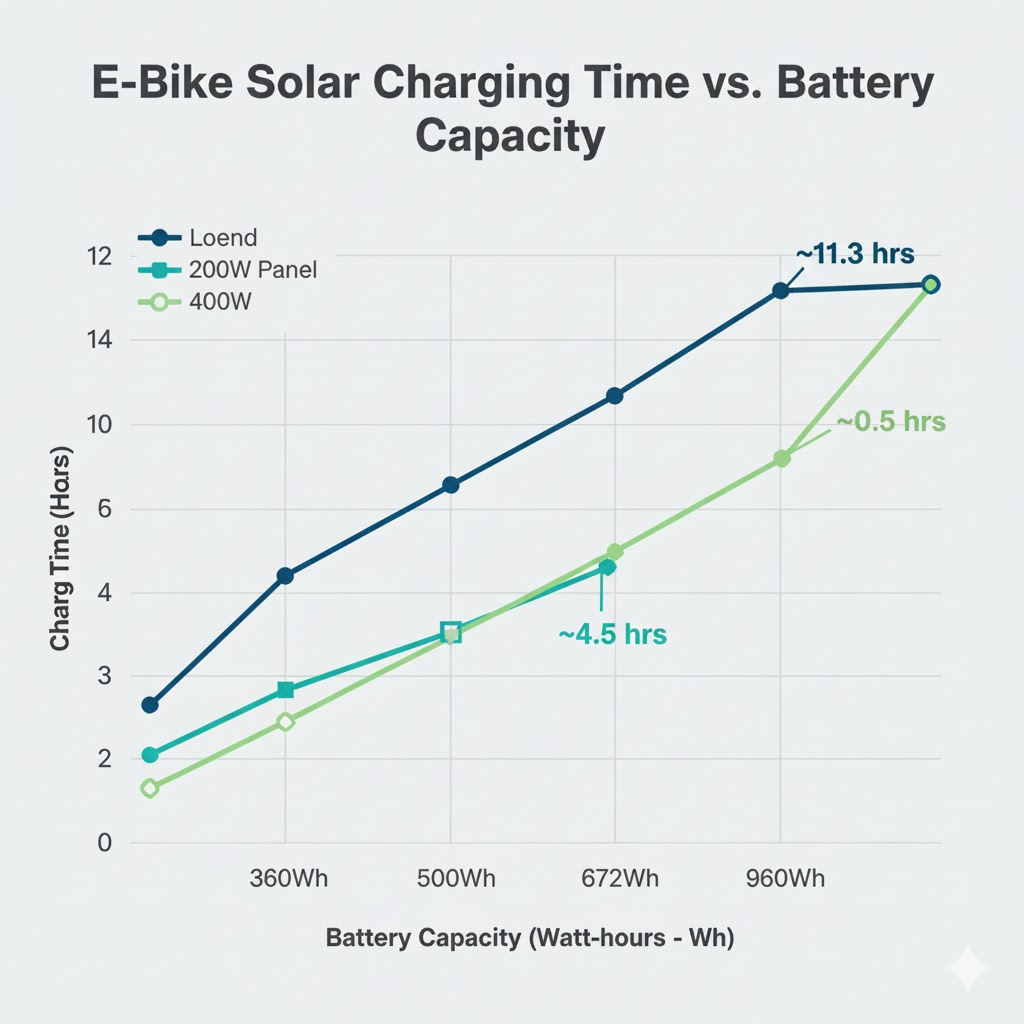
As a ballpark: in 1 PSH hour, a 200 W panel yields ~200 Wh DC before controller losses. A 48V × 14 Ah (~672 Wh) battery might need ~4–5 PSH hours at 200 W (ideal sun) for a full refill; more if clouds/angles are sub-optimal. Use PVWatts/Atlas to get your PSH, then map to panel watts.
Daily Range Gain per Hour of Sun
Range gained = (Panel_W * PSH * system_efficiency) ÷ (Wh per km). Because Wh/km varies widely with speed/terrain, model conservatively. (See PV tools above for PSH.)
Quick Sizing Rules & Safety Margins
Target 20–30% headroom in controller current and voltage.
Use fuses and proper connectors; keep cable runs short to reduce voltage drop. (General electrical practice; pair with your controller specs.)
Worked Example (kept brief)
672 Wh pack, 200 W panel, ~4.5 PSH summer day. Energy in ≈ 200 × 4.5 × 0.75 (efficiency) ≈ 675 Wh—roughly a full charge on a good day. Always confirm local PSH with PV tools.
Core Components
Quick answer: Choose quality panels (rigid = tougher/more efficient; flexible = lighter/curved), a properly sized MPPT/boost controller, correct cabling/fusing, and make sure your BMS allows external charging.
PV Panels (Rigid vs. Flexible; Durability & Efficiency)
Rigid glass-front modules offer the best durability and efficiency but are heavy and bulky. Flexible ETFE-laminated panels save weight and conform to racks/trailers but can suffer from micro-cracks, heat buildup, and shorter lifespans—buy reputable brands and ensure airflow.
Charge Controllers (MPPT vs. PWM; Boost Controllers)
Prefer MPPT for higher yield and stable charging; if your panel voltage is below required charge voltage (e.g., 18–24 V panel to a 48–52 V pack), you’ll need a boost MPPT or a dedicated DC-DC boost stage.
Inverters/DC-DC, Cables, Connectors & BMS Considerations
“Power-station” e-bikes add a branded inverter (often 1,000 W) to run appliances and to interface with foldable panels—handy for camping and off-grid work. Your e-bike BMS (battery management system) must tolerate external charging; follow manufacturer specs to avoid warranty issues.
Mounting, Aerodynamics & Safety
Quick answer: Mount solidly, seal electrics, and respect wind load. Big panels catch crosswinds—trailers and canopies are safer than broad on-bike roofs.
Rack/Frame/Trailer Mounts, Vibration & Weatherproofing
Use vibration-damping mounts and sealed junction boxes. Trailer frames accept 100–200 W panels easily and keep weight off the bike frame.
Wind Load, Handling, Braking & Stability
Large flat panels act like sails; expect cross-wind effects and longer stopping distances. Solar-bike events cap panel area (e.g., 0.75–2.5 m² visible while moving) to balance safety and performance.
Theft-Proofing and Storage
Quick-release panels invite theft; consider locking hardware and stowable foldables. Store flexible panels flat, away from sharp edges to avoid cell damage.
DIY Solar Conversion (Step-By-Step)
Quick answer: Source rated parts, preset charge voltage with a dummy load, wire/seal carefully, fuse both the array and battery sides, and test under supervision.
Parts List & Sourcing
Foldable or semi-flex PV panels (e.g., 100–200 W).
MPPT (boost) controller or DC-DC boost stage sized to your battery (e.g., ~54.6 V for 48V/13s).
Appropriate diodes, fuses, wiring, and waterproof enclosures.
A popular DIY example documented a ~40 W setup adding ~2 km/day when left in Arizona sun; higher wattage scales results.
Wiring Diagram & Assembly
Panel → blocking diode (if required) → MPPT/boost → battery charge port. Pre-set charge voltage with a dummy load before connecting the battery. Weather-seal the electronics box and strain-relieve all cables.
Testing, Troubleshooting & Best Practices
Verify polarity and target voltage before first charge.
Monitor battery temps and controller logs on the first few rides.
For longevity, consider not charging to 100% every time; partial charges (e.g., ~4.1 V per cell) can extend lithium life substantially.
Troubleshooting
- No charging: Check polarity, fuses, and that panel open-circuit voltage plus boost can reach your pack’s charge voltage.
- Erratic charging: Inspect shading/tilt and controller thermal limits; ensure panel connections are tight and dry.
- BMS refuses charge: Use the dedicated charge port; confirm controller cutoff matches the pack; some packs require “wake” via the original charger.
- Underperformance vs. spec: Verify PSH expectations, panel cleanliness, and realistic efficiency (often ~70–80% net).
Advanced Tuning (for experienced users)
- Target partial-charge profiles (e.g., ~4.1 V/cell) to extend cycle life.
- Log MPPT stats to optimize tilt/orientation for your route.
- Use correct connectors (e.g., MC4/XT90) and size wire for current and run length.
- Be cautious with parallel batteries—only if identical chemistry/state of charge and with proper protections.
Commercial Models & Innovations (2025)
Quick answer: Options span integrated solar cargo platforms, “power-station” e-bikes with branded foldables/inverters, and DIY trailers/kits.
Solar Cargo E-Bikes (e.g., SunRider, Infinite Mobility concepts)
SunRider: Integrated canopy PV; IKEA trials highlighted big CO₂ cuts vs. diesel vans; claims up to ~100 km/day solar in favorable conditions.
Infinite Mobility (Løkka/Inga): Cargo trikes with integrated PV body panels targeting self-charging operation in sun.
“Power-Station” E-Bikes with Solar Accessories (e.g., Mokwheel)
Mokwheel kits bundle 100–230 W foldables and an ~1,000 W inverter to charge the bike and run camp gear; retailers commonly quote ~4–5 hours for a solar refill in strong sun (model/conditions vary).
Solar Trailers, Kits & Aftermarket Chargers
DIY trailers and aftermarket boost-MPPT modules let you adapt most 36–52 V bikes; community builds show 100–200 W trailers as the sweet spot for stability and utility.
Use Cases
Quick answer: Solar helps most when you park in sun (commuting), stop often (delivery), or camp off-grid (touring/RV).
Commuting & Touring/Bikepacking
Tourers gain resilience: ride by day, sip sunlight at stops, arrive with charge for lights/GPS/phones. City commuters can offset top-ups on sunny parking pads.
Delivery & Urban Logistics
Cargo PV cuts plug-in time and emissions; IKEA’s pilot cited strong sustainability and service advantages for short-haul delivery.
Off-Grid Travel, Camping & RV Life
Pair foldables with an inverter to power camp appliances and refill your pack without finding an outlet.
Costs, Payback & Incentives
Quick answer: Upfront cost is panels/controllers/mounts; “fuel” can drop toward zero on sunny days. Savings depend on how much charging you shift off the grid and local PSH.
Upfront Pricing (Panels, Controllers, Mounts)
Expect US$150–600 for 100–230 W foldables, US$200–400 for e-bike-compatible inverters/MPPT/boost hardware, plus mounts and wiring. (Representative retail ranges from multiple vendors.)
Operating Costs vs. Grid Charging
Solar cuts electricity costs to near zero on sunny days; real savings depend on your PSH and how much you ride/charge off-grid. Use PVWatts/Atlas to estimate yield for your location.
Rebates, Grants & Local Incentives
Look for micromobility or fleet grants and renewable micro-grid pilots in your city; public agencies increasingly fund solar-assisted charging for e-bikes and e-cargo.
Care, Maintenance & Warranty
Quick answer: Keep panels clean, avoid deep battery cycles, and check whether third-party solar charging affects your warranty.
Panel Cleaning & Inspection
Keep panels clean of dust/salt, check for delamination or hot-spots—especially with flexible laminates.
Battery Health & Charge Practices
Avoid deep discharges; store around 40–60% if idle for weeks. Partial charging (e.g., ~4.1 V/cell) can multiply cycle life at the cost of some capacity.
Warranty & Modification Considerations
Adding third-party charging gear may void warranties—confirm with your e-bike maker or choose systems explicitly designed for your model. (General manufacturer policy guidance.)
Frequent Ask Questions

James Parker
James Parker is an environmental expert, writer, and the founder of Envirose.com. Over the years, he has dedicated his work to studying sustainable practices, renewable energy solutions, and eco-conscious lifestyles. Through Envirose, he aims to inspire individuals to make small yet powerful changes in their daily lives that can collectively create a positive impact on the planet. When he’s not writing or researching, you’ll often find him outdoors, exploring nature and finding new ways to live in harmony with it.