Solar powered flashlights
Written by Admin | Nov 20, 2025
What is a Solar-Powered Flashlight (and Who It’s For)
Snippet-friendly one-line definition:
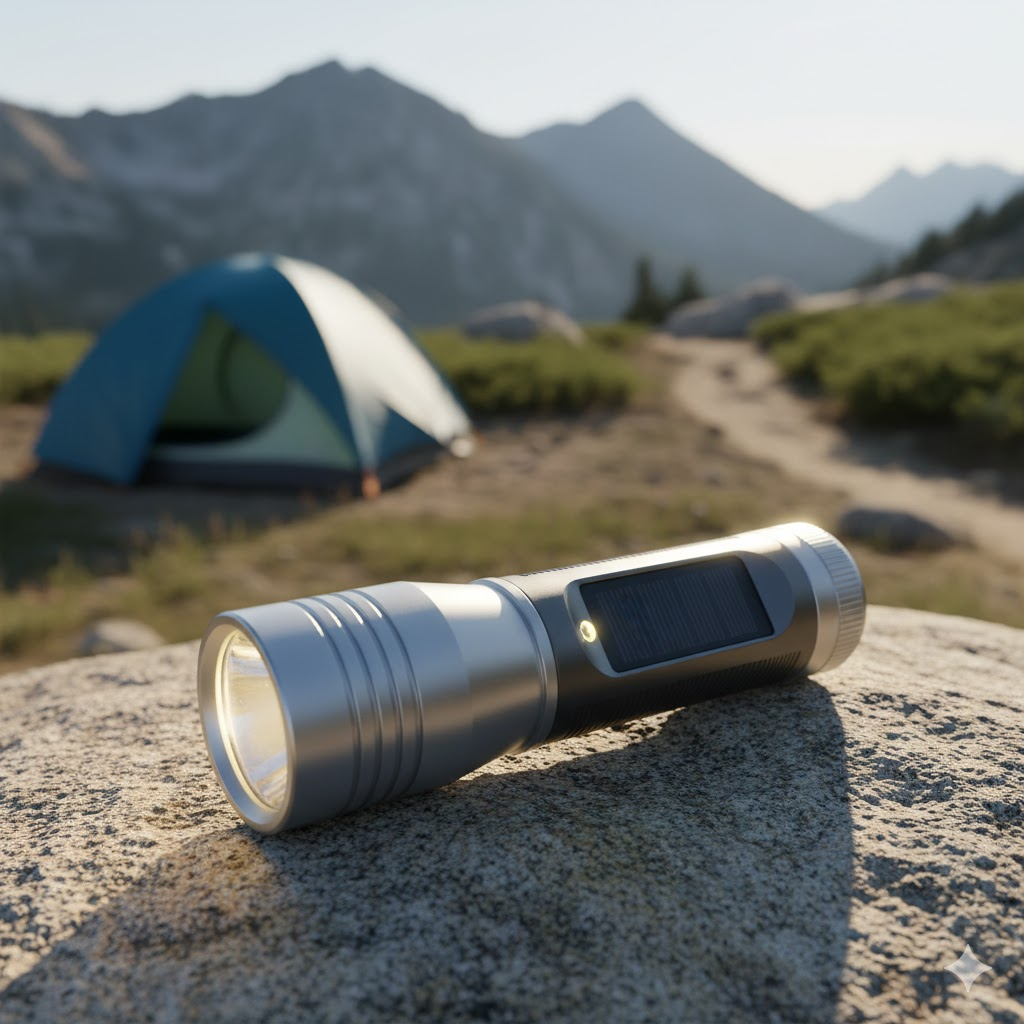
A solar-powered flashlight is a rechargeable LED torch with a built-in solar panel that converts sunlight into stored battery power, so you can charge in daylight, top up via USB, and get dependable light during outages, travel, or outdoor trips.
A solar-powered flashlight is a torch that stores energy from light—usually the sun—in a rechargeable battery and then drives efficient LEDs to produce a bright beam. They’re designed for people who want dependable light with minimal fuss: campers and hikers, drivers who keep an emergency kit in the trunk, families preparing for outages, and anyone who’d rather not chase disposable batteries. Compared with regular battery torches, the best solar models pair a small photovoltaic (PV) panel with rechargeable cells and sensible electronics so you can charge in sunlight, top up via USB when you’re in a hurry, and get light when the grid goes dark.
How a Solar-Powered Flashlight Works
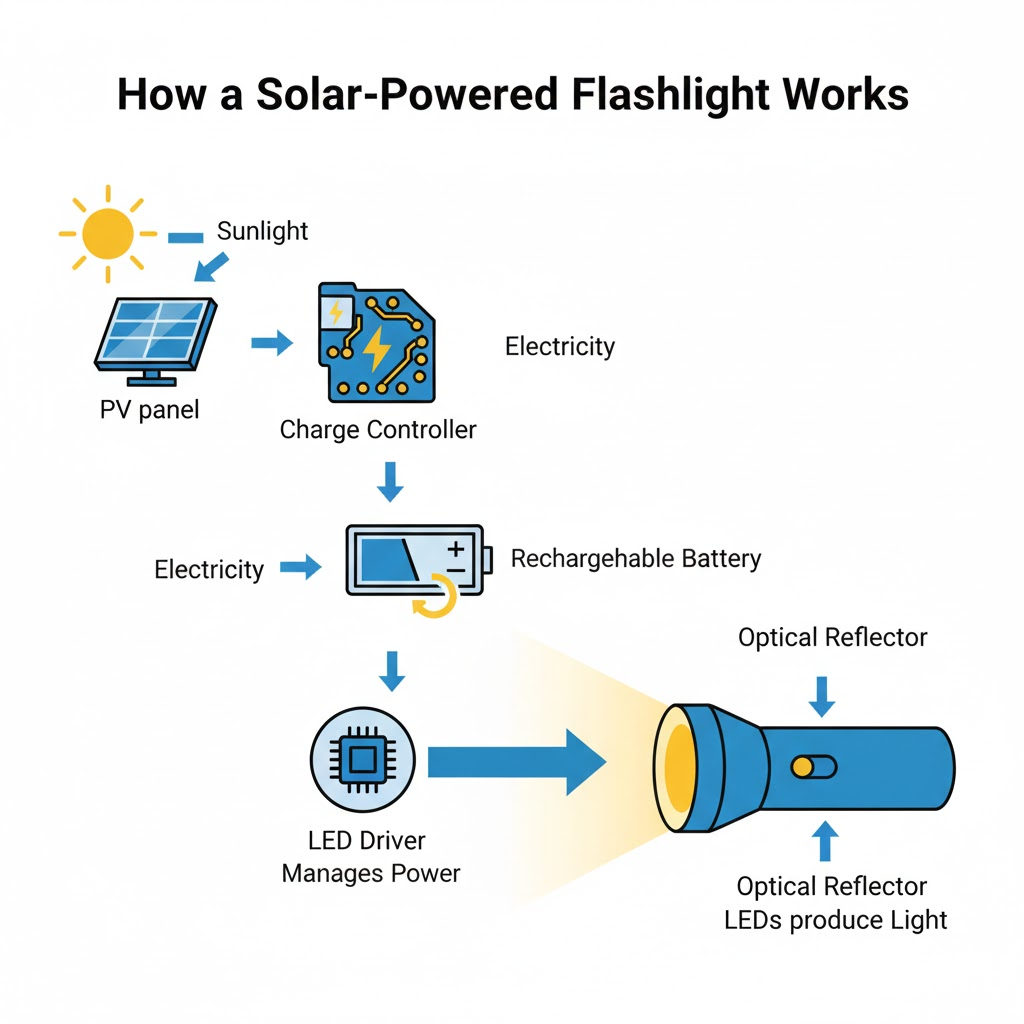
At a high level, the PV panel converts light into electricity, a charge controller feeds that energy into a rechargeable battery, and the battery powers LEDs through a driver that controls brightness and modes. Each part matters for performance, safety, and longevity.
Photovoltaic Panel Basics (PV Type, Size, Efficiency)
Small flashlights typically use mono- or polycrystalline silicon PVs (good efficiency for their size) or, in some compact or indoor-friendly designs, amorphous silicon that tolerates diffuse light better. Consumer mono-Si modules commonly reach ~20% efficiency today, while amorphous is lower but works reasonably under low light—useful through windows or on overcast days. Panel size limits how much energy you can harvest in a day; larger panels charge faster given the same sun. Expect meaningful losses when charging behind glass; it works, but slower than outdoors in direct sun.
Battery Chemistries (Li-ion vs. LiFePO₄ vs. NiMH)
- Li-ion (NMC, etc.): High energy density, common in compact torches; dislikes deep cold and needs protection circuits. Capacity and charge acceptance drop in low temperatures.
- LiFePO₄ (LFP): Lower energy density than Li-ion but notably safer and more cycle-durable—why it’s favored for solar storage and rugged gear.
- NiMH (AA/AAA): Lower voltage and density, but robust and available in “low-self-discharge” variants that hold charge for months. Good for replaceable-cell designs.
Charge Controllers & Protection Circuits
Modern lights include basic battery management: over-charge/over-discharge protection, temperature cutoffs, and sometimes low-temperature charge inhibit (especially important with Li-ion). These circuits keep the battery healthy and reduce fire risk over years of use.
LEDs, Optics & Beam Pattern Fundamentals
LEDs are efficient, rugged sources. A reflector or TIR optic shapes output:
- Throw (high candela) concentrates light far downrange.
- Spill/flood spreads light for work up close.
Candela tells you intensity at the center; lumens tell you total light. Beam distance and impact/drop ratings are standardized under ANSI/PLATO FL-1, which also defines runtime, water resistance, and more—useful apples-to-apples numbers when comparing models.
Advanced Notes for Enthusiasts
- Controller behavior: Tiny lights often use simple linear controllers; higher-end designs may mimic MPPT-like behavior to squeeze more energy in changing light.
- Low-light PV: Amorphous silicon can outperform mono in very dim, diffuse indoor light; mono wins in bright sun per area.
- Battery profiles: LiFePO₄ prefers slightly different charge curves and tolerates more cycles; many lights inhibit charging at low temps to protect Li-ion.
- Wh vs mAh: Compare capacity in watt-hours (Wh) across chemistries/voltages; Wh = (mAh × nominal V) / 1000.
Charging Methods & Times
Charging speed depends on panel area, sunlight strength/angle, battery capacity, and electronics. Most quality lights also include USB for days when the weather won’t cooperate.
Solar Charging (Sun Conditions, Orientation, Expected Times)
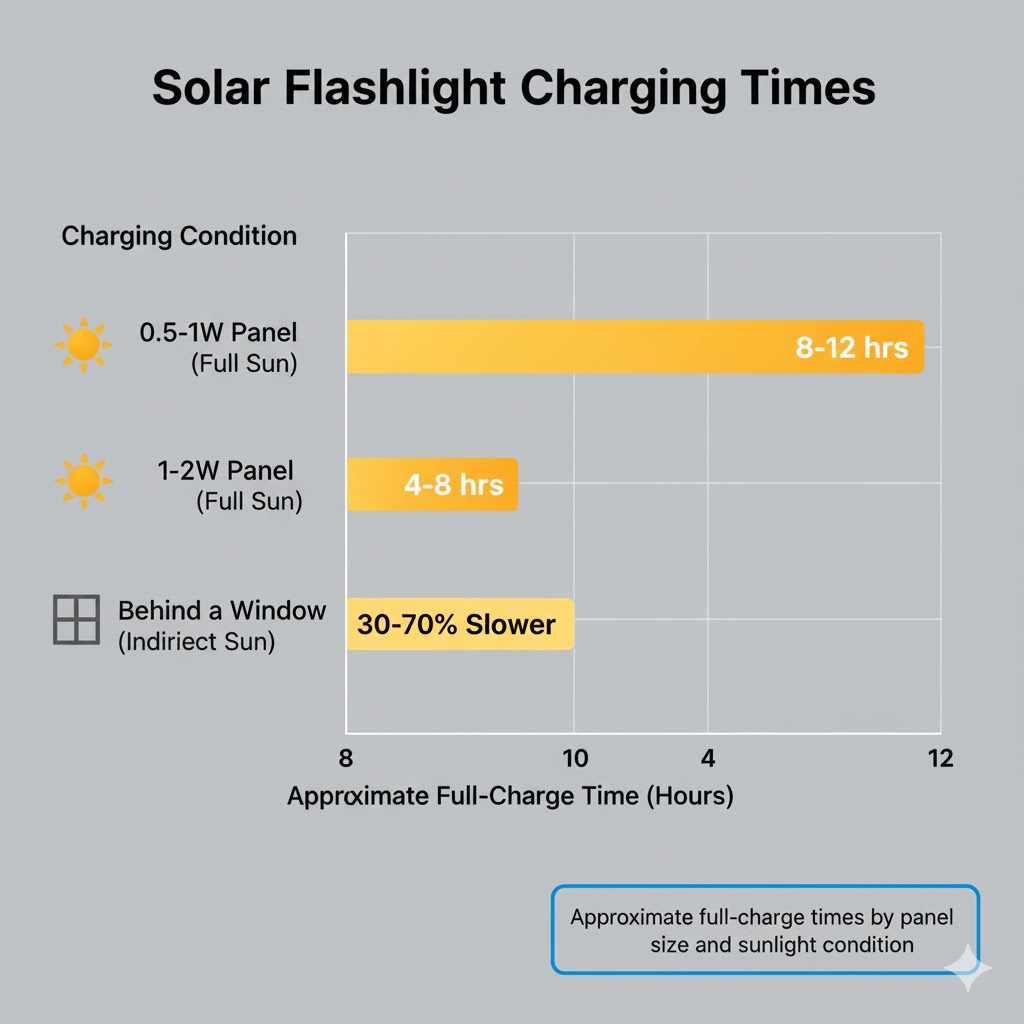
Face the panel directly at the sun and re-angle a couple of times through the day to shorten charge time. Behind a window works but can be significantly slower due to reflection and absorption by glass; outdoor direct sun is best. In practical terms, a pocket panel might need a sunny day to fill a small cell; a larger panel can finish in hours.
Quick Expectations (Ranges)
| Panel & Battery (typical) | Full-sun outdoor charging (approx.) | Notes |
| 0.5–1 W panel → ~1000–1500 mAh cell | ~8–12 hours | Mid-latitude, clear day; angle matters |
| 1–2 W panel → ~1500–2500 mAh cell | ~4–8 hours | Faster near midday summer sun |
| Behind a window (any panel) | Often 30–70% slower | Glass/angle losses; varies widely |
(Times are indicative; results vary by latitude, season, temperature, controller efficiency, shading, and cell health.)
USB Charging (Fast-Charge Considerations)
USB-C or Micro-USB inputs usually accept 5V at 0.5–2A. Unless the specs explicitly support fast-charge protocols (QC/PD), stick to standard 5V adapters; higher-voltage chargers won’t help and may damage 5V-only devices. (Check your manual for the allowed input.)
Hand-Crank/Kinetic Backup (When It Helps)
Cranks are for true emergencies: turning the handle for a minute can provide several minutes of usable, low-mode light—enough to read a map or move around safely when the battery is empty and the sky is dark. Expect short bursts, not hours.
Can Indoor/Artificial Light Charge a Solar Flashlight?
Yes—very slowly. Indoor light levels are a tiny fraction of sunlight. Some PV techs (like amorphous silicon or certain perovskite/organic cells) harvest indoor spectra more efficiently, but for typical small panels, indoor charging is a trickle. Plan on USB top-offs if you store the light indoors.
Key Features & Specifications to Compare
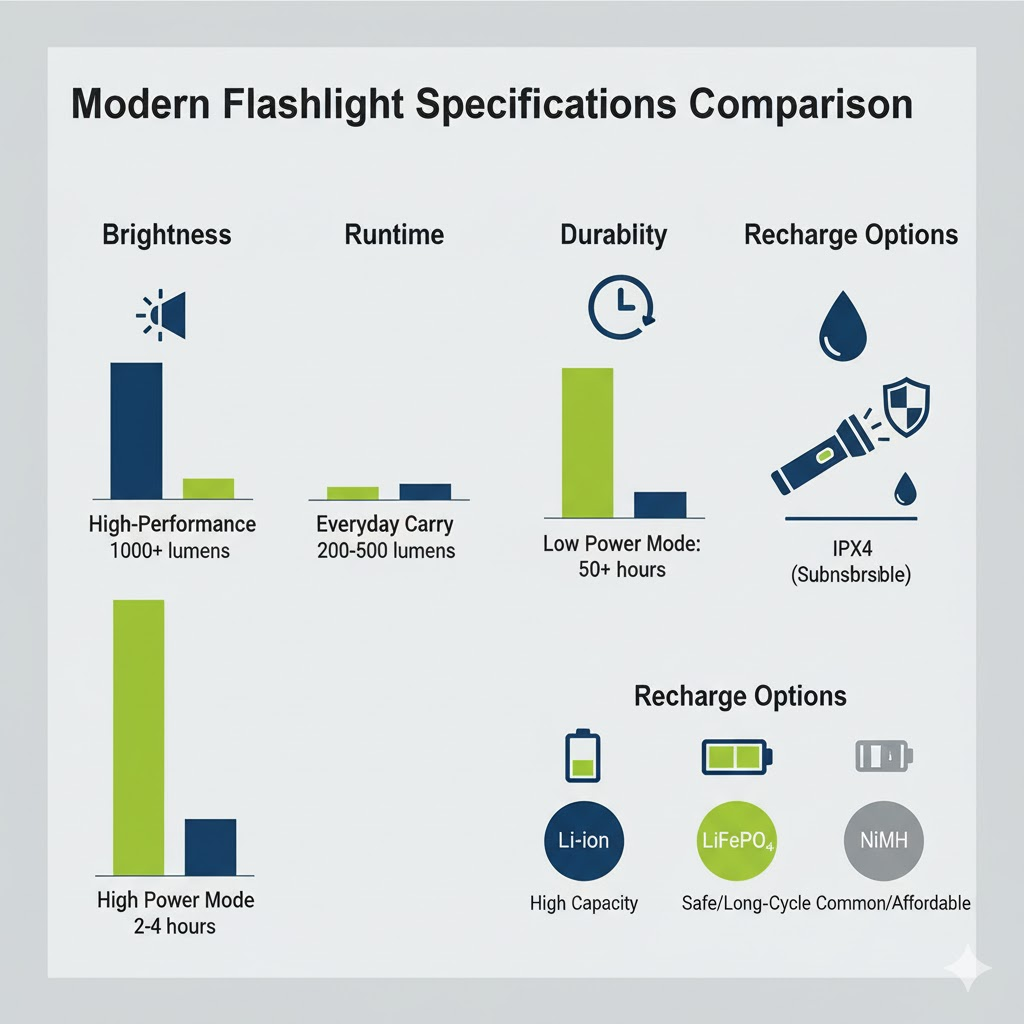
Brightness (Lumens) & ANSI/PLATO FL-1 Ratings
Lumens = total output. The FL-1 standard defines how to measure it, so two FL-1-rated lights are directly comparable. Also look for standardized runtime and impact ratings.
Beam Distance, Candela & Spill vs. Throw
Candela indicates peak intensity and relates to beam distance; higher candela = farther reach. Wide spill helps with tasks and walking; a tight throw helps spotting and signaling. Check both specs, not just lumens.
Runtime & Modes (Low/Med/High, Strobe/SOS, COB Work Light)
Multiple modes let you preserve energy (low) or push brightness briefly (high). Side “COB” work lights give broad, shadow-soft flood for repairs and camp tasks.
Durability & Weather Resistance (IP Rating, Drop Rating, Operating Temps)
Look for at least IPX4 for rain resistance, IPX7 for temporary submersion. Drop ratings (per FL-1) indicate survivability. Cold weather reduces Li-ion performance—plan accordingly in winter.
IP Quick Guide
| IP Rating | What it Means | Typical Use |
| IPX4 | Resists rain/splashes | Everyday carry, camping |
| IPX5–IPX6 | Resists heavy spray/jets | Marine/vehicle work |
| IPX7 | Temporary immersion (1 m, ~30 min) | Wet environments/boat use |
Battery Capacity & Power Bank (USB-Out) Functionality
Some lights double as small power banks. Check capacity (mAh and Wh) and USB-out specs; they’re fine for a phone boost in a pinch, but don’t expect full multi-charge power-bank performance from a tiny flashlight battery.
Size, Weight, Ergonomics & Controls
A light you actually carry is the one that helps: consider grip, switch feel (gloves?), and whether the interface is simple under stress.
Mounting/Attachments (Magnet, Carabiner, Headband/Lantern Conversion)
Magnets, clips, stands, and lantern diffusers make a small light more useful for repairs, tents, or tabletop lighting.
Solar Flashlight vs. Primary-Battery & Plug-In Rechargeable Flashlights
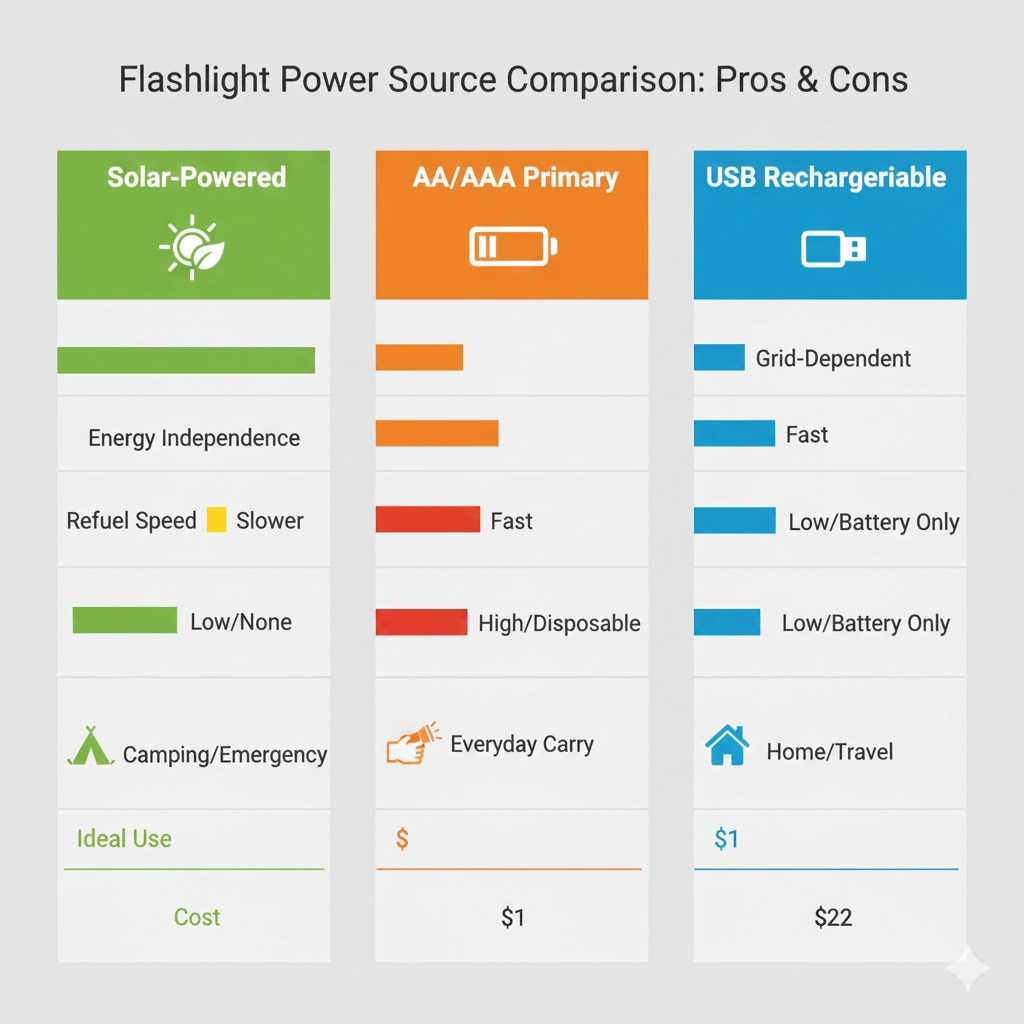
At-a-Glance Comparison
| Type | Energy Source | Refuel Speed | Independence | Waste | Ideal Use |
| Solar flashlight | Sunlight + often USB | Solar = slow; USB = normal | High (off-grid) | Low (reusable) | Emergencies, camping, glove box |
| AA/AAA primary | Disposable cells | Fast (swap cells) | Medium | Higher | Short trips, universal availability |
| USB-rechargeable | Wall/power bank | Fast via USB | Low if no power | Low (reusable) | Daily use with grid access |
Pros & Cons vs. AA/AAA Models
Pros: energy independence, fewer disposables to buy and throw away.
Cons: slower refuel in bad weather; panel size limits daily harvest. Disposable-battery flashlights create waste; solar/rechargeable cuts that impact over time.
Pros & Cons vs. USB-Rechargeable/Power-Bank Lights
USB-only lights recharge quickly from the wall but depend on the grid. Solar models are slower yet self-sufficient, and many also offer USB for speed when available.
When a Lantern or Headlamp is a Better Choice
Need hands-free task lighting or campsite ambience? Choose a headlamp or lantern. Flashlights excel at directed beams; lanterns/headlamps win for area light and chores.
Best Use Cases
Emergency Preparedness & Disaster Kits
Solar flashlights ride out long outages; pair with a USB power bank for cloudy spells. Many “emergency” models layer in SOS/strobe and phone-charging to keep you reachable.
Field Notes
- “Three days without power—our solar light plus a small power bank covered evening tasks.” — Ayesha, Islamabad
- “Kept one on the dashboard; even intermittent sun kept it topped off.” — Marco, Tucson
Camping, Hiking & Off-Grid Travel
Out all day? Clip your light to a pack to harvest sun, then use low modes at night. For alpine or winter trips, remember cold-weather battery behavior.
Vehicle & Roadside Safety
Keep one in the glove box for breakdowns or tire changes; pick models with a broad flood (COB) and reflective accents.
Everyday Carry (EDC) Considerations
For pockets, prioritize weight, a simple UI, and USB-C. A small panel won’t fully recharge daily, but it slows self-discharge between uses.
Limitations & Trade-Offs to Know
Charge Time, Weather Dependence & Seasonal Performance
Short winter days and low sun angles mean slower solar charging; cloud cover and shade can stretch times dramatically.
Self-Discharge & Long-Term Storage Behavior
Store Li-ion roughly half-charged in a cool place for the longest life; avoid deep discharge in storage. LSD-NiMH keeps charge well over months.
Panel Size vs. Brightness Expectations
A tiny panel plus a very bright LED equals limited sustained use from solar alone—balance your expectations and lean on USB when needed.
How to Choose the Right Solar-Powered Flashlight (Step-by-Step)
- Define your use-case & brightness needs
- Pick battery chemistry & capacity
- Choose charging inputs (solar + USB + crank)
- Check standards & ratings (ANSI FL-1, IP)
- Budget, warranty & brand support
What to do next: Print a checklist with your must-haves (beam type, runtime, IP rating, battery chemistry). Shortlist two models that meet your use-case, then compare FL-1 runtimes and IP ratings side-by-side.
Care, Maintenance & Safety
Panel Cleaning & Handling
Dust and film reduce harvest. Wipe the panel with a soft, damp cloth; avoid harsh cleaners that can haze plastics.
Battery Care, Storage State-of-Charge & Temperature
Keep batteries between moderate temperatures; cold cuts performance and fast charging in the cold risks plating with Li-ion. Store Li-ion around 40–60% SOC if shelving for months.
Water Exposure, Seals & Gasket Checks
Rinse off salt spray, dry the charge port before plugging in, and inspect O-rings; water resistance depends on intact seals.
Tips to Maximize Solar Performance
Orientation & Tilt (Outdoor vs. Window Charging)
Aim the panel directly at the sun and re-aim at midday. Window charging works but is slower; direct outdoor sun is best.
Cloudy/Winter Strategies & Partial-Sun Charging
Use a brighter external panel (when supported) or top up by USB on low-sun days. Expect longer times in winter due to low angles and shorter daylight.
Using Low-Power Modes to Extend Runtime
Use low/medium for routine tasks and save “high” for brief needs; side COB work lights give efficient area illumination.
Troubleshooting
Troubleshooting Quick Table
| Symptom | Likely Cause | Quick Fix |
| Very slow charging behind glass | Window losses & poor angle | Charge outdoors in direct sun; re-aim at midday |
| Won’t charge in cold | Li-ion charge temp limits | Warm to room temp; then charge |
| Runs briefly then shuts off | Aging battery / protection trip | Full USB charge; if repeats, replace battery |
| Flicker in high mode | Low voltage / driver overheating | Charge fully; try medium mode; check ventilation |
| Moisture in lens/head | Compromised seal/O-ring | Dry thoroughly; re-seat O-rings; avoid charging wet |
Won’t Hold a Charge
If the light fades quickly after charging, the battery may be aged. Try several full solar/USB cycles; if it still underperforms, contact the maker for a replacement pack or service.
Charges but Won’t Turn On
Check lockout/safety modes, confirm the tailcap is tight, and try a reset (if the manual lists one). Inspect for moisture in the head or port.
Panel Damage/Yellowing or Poor Charging
Hazed plastic or cracked cells reduce harvest. Clean gently; if output remains low in full sun, the panel may need replacing.
Flicker or Mode-Switching Issues
This can be a weak battery or a switch/driver fault. Fully charge via USB first; if it persists, seek warranty support.
Environmental Impact & Sustainability
Energy Savings & Lifecycle Considerations
Swapping single-use batteries for rechargeables reduces waste and lifecycle impacts; multiple LCAs show significant environmental benefits for rechargeable use over disposables when used properly.
End-of-Life & Recycling (Batteries and Electronics)
Never throw Li-ion packs in household trash; use battery take-back programs or municipal drop-offs.
Top Solar-Powered Flashlight Categories (Buyers Overview)
Ultra-Compact EDC Models
Pocketable lights with small panels for slow top-offs; best for glove boxes and everyday utility.
Multi-Function Emergency Tools (Work Light, Window Breaker, Seatbelt Cutter)
Designed for cars and disaster kits: SOS modes, side floods, and sometimes USB-out for phone boosts.
High-Output Models for Outdoor Use
Bigger heads, higher candela, better heat sinking; pair with USB-C for quick recharges before the next trail.
Budget Picks (Under $20)
Value models can be great for backup kits—check that they publish honest FL-1 specs and real IP ratings.
Conclusion & Next Steps
- Match your use-case (emergencies, camping, EDC) to beam type, runtime, and IP rating.
- Choose your battery chemistry (LiFePO₄ for longevity/safety; Li-ion for compact energy; NiMH for replaceable cells).
- Prefer solar + USB inputs; treat a hand-crank as an emergency backup.
Call to action: Shortlist two models and compare FL-1 runtimes, candela/beam distance, IP rating, and battery capacity in Wh. If you have experience with winter charging or dashboard-window charging, share your tips in the comments—your data helps other readers choose confidently.
Frequent Ask Questions

James Parker
James Parker is an environmental expert, writer, and the founder of Envirose.com. Over the years, he has dedicated his work to studying sustainable practices, renewable energy solutions, and eco-conscious lifestyles. Through Envirose, he aims to inspire individuals to make small yet powerful changes in their daily lives that can collectively create a positive impact on the planet. When he’s not writing or researching, you’ll often find him outdoors, exploring nature and finding new ways to live in harmony with it.