Solar Tubes Skylights
Written by Admin | Nov 20, 2025
What Are Solar Tubes ?
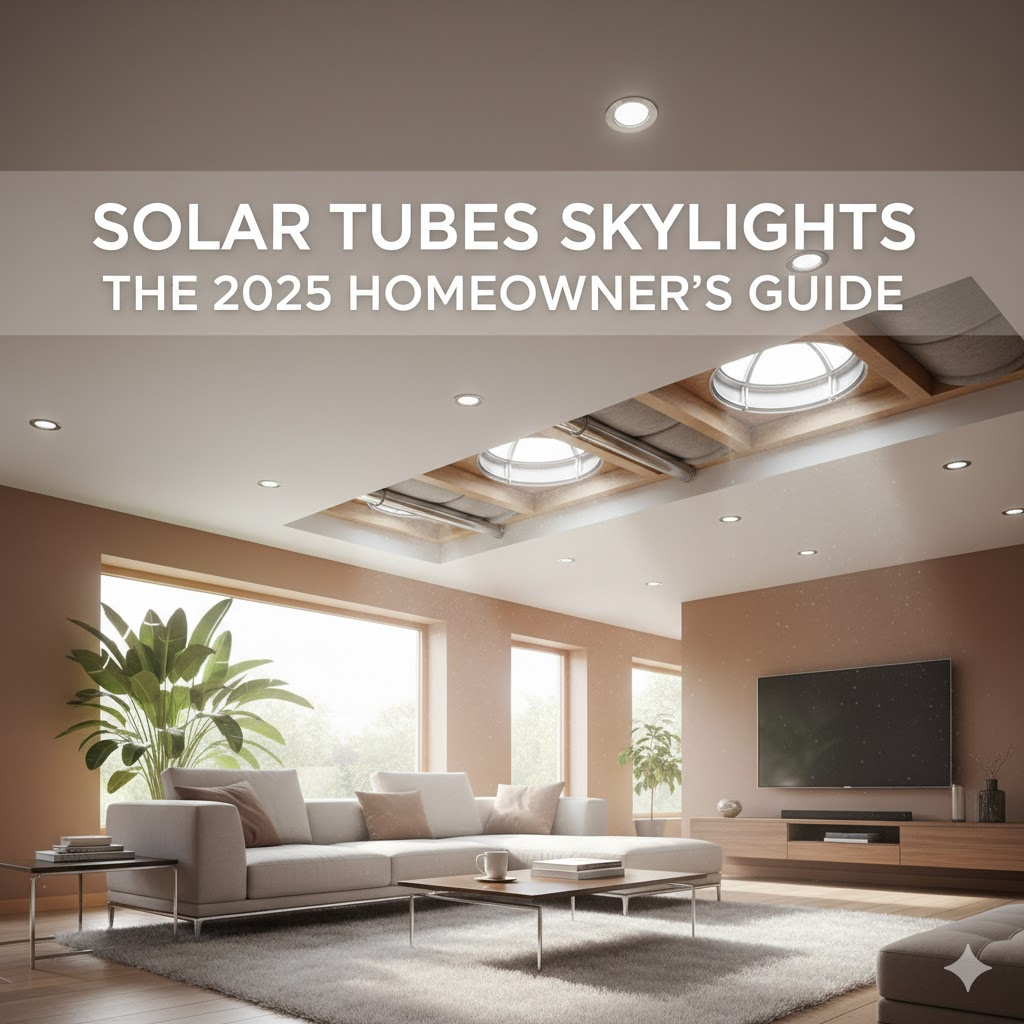
Tubular skylights—often called solar tubes, sun tunnels, or light tubes—are compact daylighting systems that channel sunlight from a small roof collector through a highly reflective tube to a diffuser in your ceiling, creating a soft, natural glow that looks a lot like a recessed light. They’re designed for tight spaces where a full skylight won’t fit and can usually be installed without changing your roof framing. Common residential diameters are 10″ and 14″ (larger 21–22″ units are used when you need more light or in select residential/commercial cases).
How Solar Tubes Skylights Work
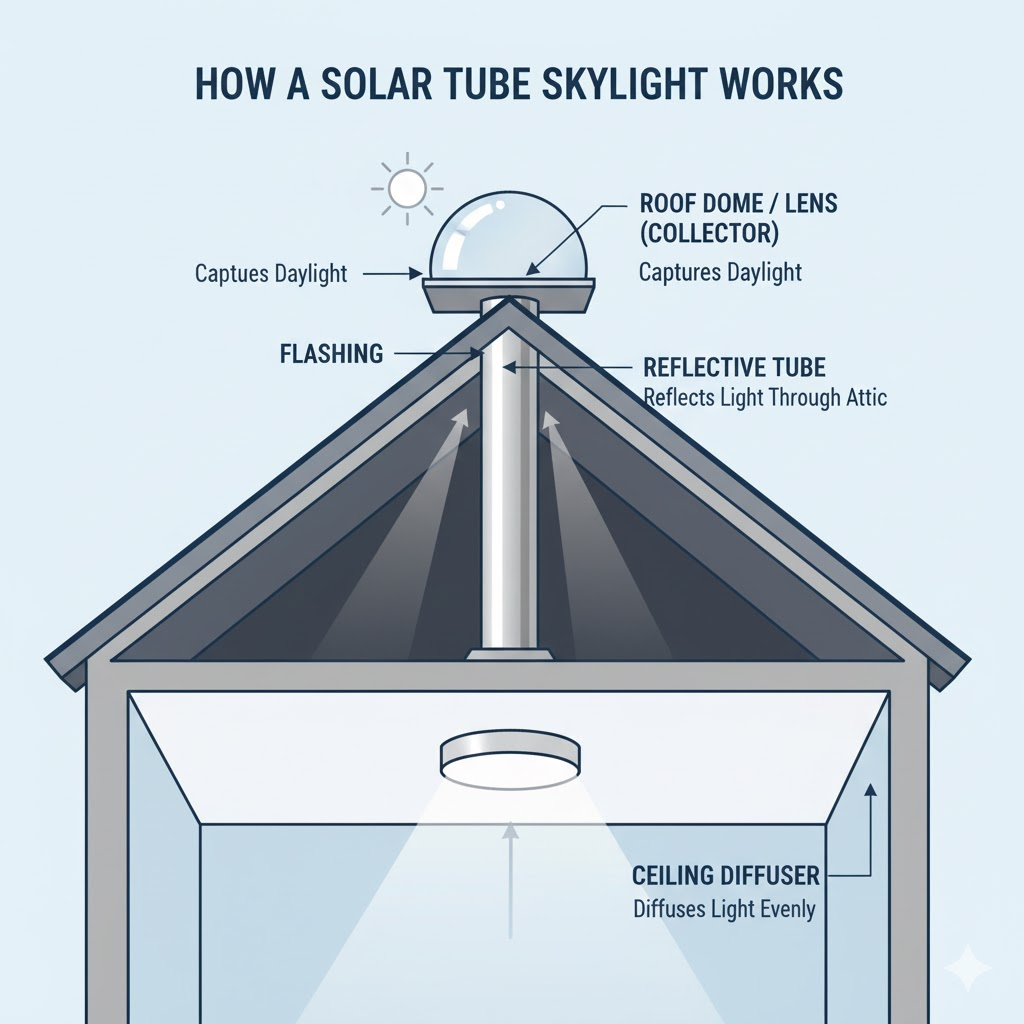
A clear or low-profile roof lens or dome gathers daylight, which then bounces down a mirror-like tunnel to a ceiling diffuser that spreads light evenly across the room. The tube’s inside surface is engineered for very high reflectance so light travels efficiently—even around bends—while the diffuser tempers hotspots and glare. Rigid tunnels carry more light; flexible tunnels are easier to snake around obstacles.
Key Components (Dome, Flashing, Reflective Tube, Diffuser)
- Collector (dome/flat lens): Weather-resistant acrylic or glass lens that captures daylight and blocks most UV.
- Flashing: Roof-integrated metal base that sheds water and seals the penetration.
- Reflective tube: Bright, mirror-grade tunnel that transports light with minimal loss.
- Diffuser/trim: Ceiling fixture that spreads light; various decorative and performance options exist.
Rigid vs. Flexible Tubes
Rigid: Highest light output; best when you can run a straighter path.
Flexible: Easiest around obstructions; slightly lower output due to internal texture.
Manufacturers offer elbows and extension tubes so you can navigate framing while preserving brightness.
Common Sizes (10″, 14″, 21″) & Light Coverage
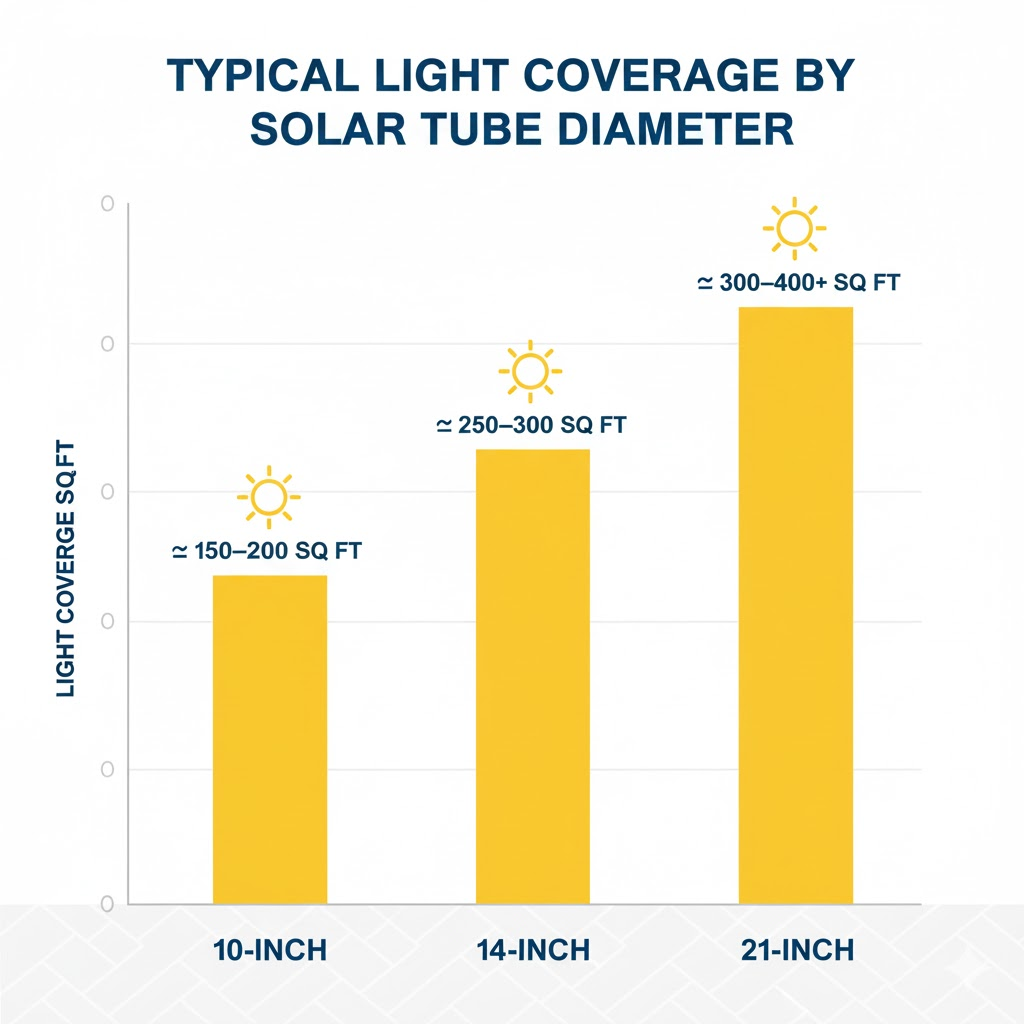
- 10″ (~160/“160 DS” or VELUX 10″): ~150–200 sq ft typical coverage.
- 14″ (~290 DS or VELUX 14″): ~250–300 sq ft typical coverage.
- 21–22″: for large spaces or commercial-scale brightness. Coverage varies with sun angle, tube length, and number of bends; use manufacturer calculators for precise expectations.
Size & Coverage Quick Reference (additive helper, not a replacement)
| Tube Size | Typical Coverage | Good For | Notes |
| 10″ | ~150–200 sq ft | Small baths, hallways, closets | Best with short, straight runs |
| 14″ | ~250–300 sq ft | Kitchens, larger baths, corridors | Consider dimmer for bedrooms |
| 21–22″ | 300–400+ sq ft | Big rooms / light-hungry areas | Check route and structure |
Quick Glossary (plain-English terms)
- TDD (Tubular Daylighting Device): Another term for a solar tube/tubular skylight.
- Flashing: The roof base that keeps water out where the tube penetrates the roof.
- Diffuser: The ceiling lens that spreads light softly across the room.
- U-factor: How well a window/skylight resists heat loss (lower is better).
- SHGC (Solar Heat Gain Coefficient): How much solar heat passes through (lower is cooler in hot climates).
Solar Tubes Skylights vs. Traditional Skylights
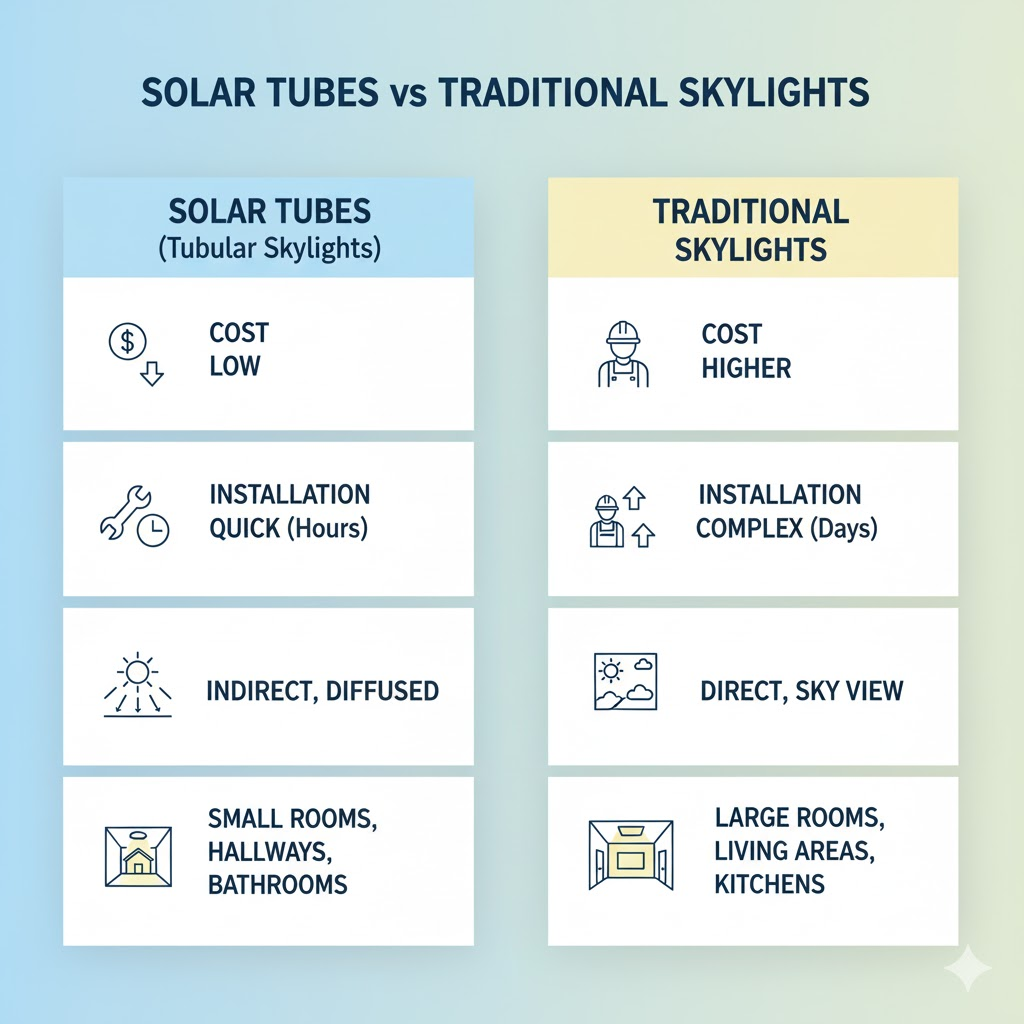
Quick Comparison Table
| Feature | Solar Tubes (Tubular Skylights) | Traditional Skylights |
| Typical Installed Cost | ~$500–$1,000 | ~$1,000–$3,000+ |
| Install Complexity | Low (few hours typical) | Medium–High (framing/finishing) |
| Heat Gain (Summer) | Lower (indirect light) | Higher (direct sun) |
| View/Venting | No sky view / no vent | Sky view / vent options available |
| Great For | Halls, baths, closets, pantries | Living rooms, kitchens, stairwells |
| Aesthetic Impact | Subtle, fixture-like | Architectural focal point |
Pros of Solar Tubes
Lower installed cost and simpler, faster installs.
Minimal heat gain in summer compared with direct sun from skylights.
Fit between rafters; great for small or windowless rooms.
Cons of Solar Tubes
No sky view and less architectural drama.
Daylight varies with weather/time; separate lighting is needed at night (unless you add a night-light kit).
Pros of Skylights
Wide sky views; can open for ventilation and design impact.
Some models boost resale appeal and can provide passive solar warmth in winter when designed correctly.
Cons of Skylights
Higher installed cost and more complex framing/finishing.
Greater summer heat gain and potential UV transmission compared with indirect, filtered tubular daylight.
Best Rooms & Use Cases for Each
Solar tubes: hallways, closets, interior baths, laundry rooms, pantries—places needing daytime brightness without a view.
Skylights: living rooms, kitchens, stairwells, and spaces where views, venting, or architectural effect matter most.
Cost of Solar Tubes Skylights vs. Skylights
Price Factors (Size, Tube Length, Elbows, Roof Type, Labor)
Final price depends on tube diameter, total length, number of bends, roof material (tile/metal vs. asphalt), attic access, and local labor. Complex paths and specialty flashings add cost.
Typical Price Ranges (DIY vs. Professional)
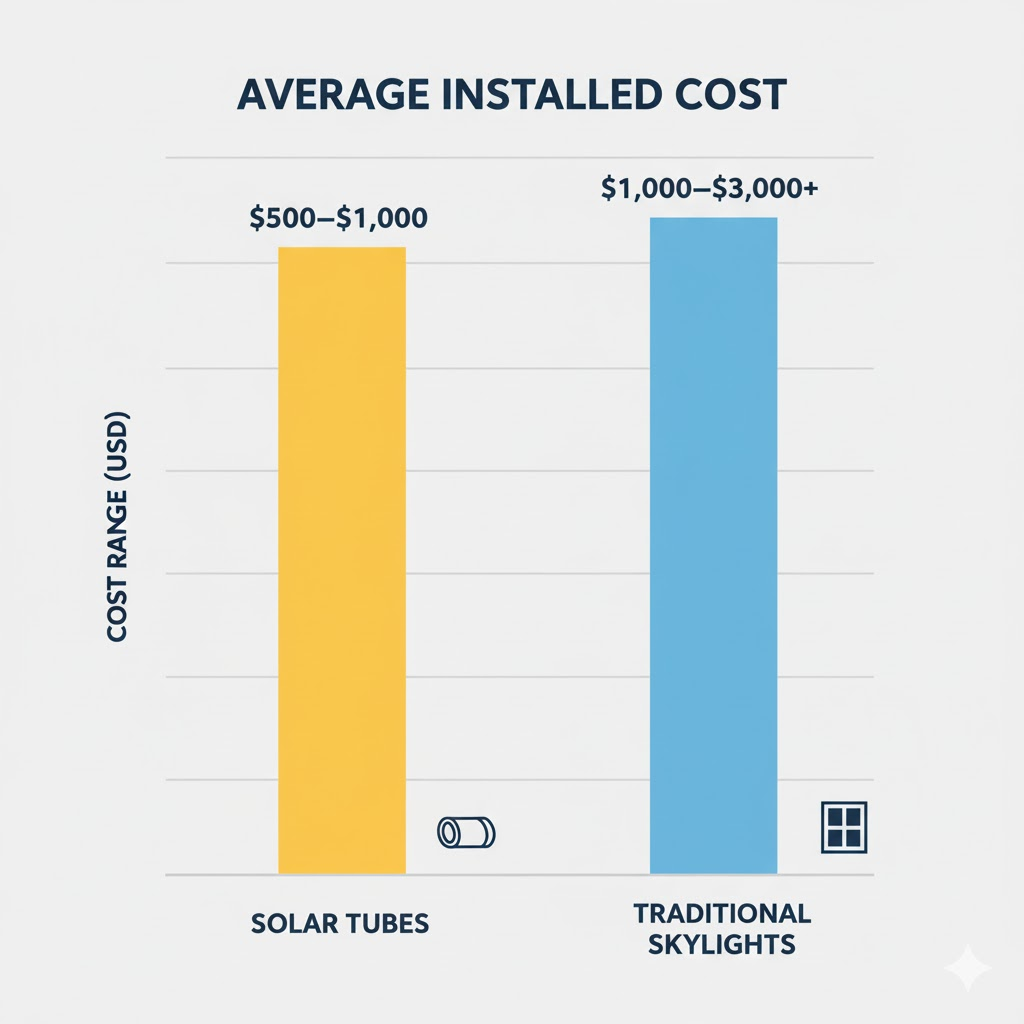
Tubular skylights: about $500–$1,000 installed on average; DIY kits typically $200–$500 for materials.
Traditional skylights: commonly $1,000–$3,000 installed, with higher ranges for large/venting models.
Energy Savings & Operating Costs
Tubular systems provide daylight without electricity during the day and typically reduce AC loads versus direct-sun skylights, improving overall energy efficiency in warm seasons. Operating costs are near-zero aside from optional accessories.
Sizing, Placement & Design
Room Suitability (Hallways, Closets, Bathrooms, Kitchens)
Pick tube size by room area and task needs: 10″ works for small rooms; 14″ suits medium rooms; use multiples for larger spaces. Bathrooms and corridors respond especially well.
Tube Length, Bends & Lumen Output
More length and sharper bends reduce delivered light. Manufacturers publish guidance and calculators to predict foot-candles; plan the straightest feasible route.
Roof Pitch, Orientation & Obstructions
Sun angle, roof pitch, and tube routing all affect output. Most pitched-roof kits target roughly 15°–60° slopes, with special models for flat roofs. Orient collectors toward stronger sun for better results.
Quick Buying Checklist (adds UX value without repeating detail above)
- Room area & task brightness goal
- Straightest possible route; minimize bends
- Roof type/pitch; matching flashing kit
- Need for dimmer/blackout or night-light kit
- Climate risks (hail, hurricane, heavy snow)
- Permit requirements & installer credentials
- Warranty terms for dome, tube, diffuser, accessories
Accessories & Options
Diffusers, Daylight Dimmers & Blackout Controls
Swap diffusers for different looks and add daylight dimmers/controllers to modulate brightness—from movie-dark to full sun—via wall switch or solar-powered remote.
Everyday example: Dim the bedroom on weekend mornings or black out a media room for movies without installing heavy shades.
Integrated Night Lights & Electric Light Kits
Add a solar night-light (soft glow after dark) or an electric light kit so the same ceiling fixture provides nighttime lighting.
Everyday example: A gentle night-light in a hallway or bath helps with safe 2am trips without harsh overheads.
Ventilation Add-Ons & Smart Controls
Some brands offer ventilation add-ons for baths and laundry rooms. VELUX supports venting via a manifold that connects to a third-party fan. Energy kits and smart accessories can further tune performance.
Everyday example: Pair a bathroom sun tunnel with a vent kit to clear humidity after showers.
Installation & Codes
DIY vs. Professional Installation
Straight, short runs on asphalt shingle roofs are often DIY-friendly; tile/metal roofs, long runs, and tricky attics are best left to trained installers to ensure leak-free flashing and code compliance.
Permits, Building Codes & Certifications
Most jurisdictions require a permit for new roof penetrations like skylights or sun tunnels; always check with your local building department. Energy codes (IECC) set skylight performance targets (U-factor/SHGC) that some tubular kits meet using energy upgrades.
Timeline, Weatherproofing & Leak Prevention
A routine tubular install can be completed in hours when conditions are typical. Proper flashing kits matched to roof type and pitch are essential to long-term weather tightness.
Advanced Specs (for pros)
- Climate zones: Match U-factor/SHGC recommendations by IECC zone; hotter zones typically favor lower SHGC.
- Impact & wind: In hail/hurricane regions, look for impact-rated domes/lenses and roof attachments rated for local wind speeds.
- Thermal detailing: Wrap tubes in insulated sleeves to reduce thermal bridging; seal at ceiling to limit air exchange.
- Flat roofs: Ensure tapered insulation or crickets to avoid ponding around the flashing.
Energy & Thermal Performance
Daylight Quality, Glare & UV Considerations
Diffusers deliver even, low-glare light; many collectors and glazings filter most UV to protect interiors. Choose decorative or prismatic diffusers to fine-tune the feel of daylight in the room.
Heat Gain/Loss Compared to Skylights
Because tubular systems deliver indirect light through a small aperture, they typically introduce less unwanted heat than large, direct-sun skylights, which helps in hot months.
Condensation & Insulation
Condensation risks increase with cold attics and uninsulated metal runs. Wrapping the tube, using sealed diffusers, and following manufacturer insulation details minimize moisture or thermal-bridge issues.
Health & Well-Being Benefits of Daylighting
Daylight supports circadian rhythms, mood, and alertness; better daytime light exposure can improve sleep timing and reduce fatigue. While tubular systems filter most UV (so they’re not for vitamin-D synthesis), they still deliver the visual benefits of natural light that many people find energizing and uplifting.
Maintenance & Troubleshooting
Cleaning Domes & Diffusers
Occasional cleaning of the roof lens and the interior diffuser keeps light output high. Follow manufacturer instructions for removing and wiping diffusers; avoid harsh abrasives.
Seal Checks, Condensation & Noise
Inspect exterior seals/flashing after storms. If you notice interior condensation, check attic insulation around the tube and verify vent accessories are ducted correctly. Wind noise usually points to loose exterior parts that need tightening.
More quick fixes
- Yellowed or cloudy dome: Replace the outer lens/dome to restore clarity and output.
- Dimmer not responding: Check power/remote battery, re-pair the controller, and verify the damper isn’t obstructed.
- Flat-roof ponding: Add tapered insulation or a cricket and re-seat flashing if needed.
Warranty & Lifespan
Typical warranties: VELUX Sun Tunnels—10-year product and installation coverage; reflective tube often longer. Solatube Daylighting System components—10 years (electrical add-ons commonly 5 years). Sun-Tek tubular skylights—often 10 years (glass series up to 20 years, model-dependent). Always confirm your exact model’s terms.
What to Do Next (CTA)
Measure your room, pick a size (10″ vs 14″), confirm roof pitch and flashing, and request 2–3 quotes from qualified installers. If you’re weighing a skylight instead, compare heat gain, view, and budget side-by-side using the table above.
Helpful links:
- Internal: Skylight cost & types guide (/skylight-costs) • Roof flashing types explained (/roof-flashing-guide) • Attic condensation & insulation tips (/attic-condensation)
- External: NFRC window/skylight ratings • ENERGY STAR skylight overview • Manufacturer install guides (VELUX/Solatube/Sun-Tek)
Top Brands & Warranties (VELUX Sun Tunnel, Solatube, Sun-Tek)
VELUX Sun Tunnel: broad accessory ecosystem (dimmer, energy kit, light kit, solar night-light) and 20/10/5 warranty framework; Sun Tunnel product coverage commonly 10 years (reflective tube may be longer).
Solatube: performance-focused optics, dimmer and ventilation add-ons; 10-year component warranty (electrical often 5 years).
Sun-Tek: US manufacturer with tubular and glass skylights; tubular units commonly 10-year warranty; certain glass series up to 20 years limited.
Brand Snapshot (feature mini-comparison)
| Brand | Tube Options | Key Accessories | Roof Flashings | Typical Warranty* |
| VELUX | Rigid & flexible | Dimmer, night-light, energy kit, light kit | Asphalt, tile, metal, flat | 10 yrs (product); see model |
| Solatube | High-reflectance rigid | Dimmer, vent add-on, decorative diffusers | Broad roof range | 10 yrs components; elec ~5 yrs |
| Sun-Tek | Tubular & glass skylights | Model-dependent | Asphalt/metal options; check specs | 10 yrs tubular; glass up to 20 yrs |
*Always verify your exact model’s coverage.
Homeowner Stories (real-world snapshots)
- “Small bath, 10″ tube—took half a day and now we rarely switch the light on during the day.”
- “Kitchen, dual 14″ tubes—added a dimmer for dinner time; space feels bigger and calmer.”
- “Hallway + night-light kit—a gentle glow at night makes it safer for kids and guests.”
Frequent Ask Questions

James Parker
James Parker is an environmental expert, writer, and the founder of Envirose.com. Over the years, he has dedicated his work to studying sustainable practices, renewable energy solutions, and eco-conscious lifestyles. Through Envirose, he aims to inspire individuals to make small yet powerful changes in their daily lives that can collectively create a positive impact on the planet. When he’s not writing or researching, you’ll often find him outdoors, exploring nature and finding new ways to live in harmony with it.